
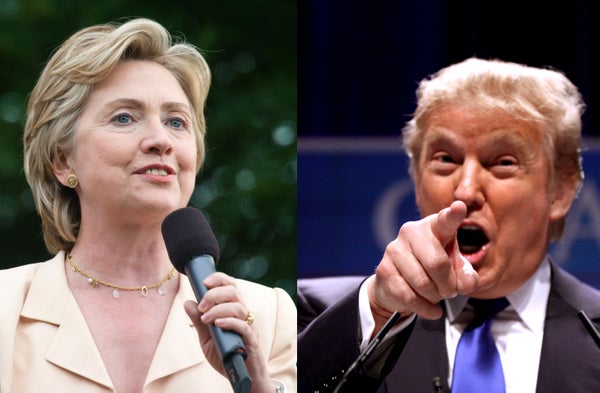
Millions of voters this election cycle are shunning “the establishment” and the meaningless platitudes that practiced politicians chew up and spit out like bubblegum. Scientists behind a recent study have come up with a technical term for this political treacle: “bullshit.” And they’ve found that people’s ability to detect it correlates with their political views.
The authors of the PLoS ONEstudy said they found that people who identify as conservative are more likely than their liberal counterparts to find such meaningless statements profound. What’s more, vulnerability to bullshit is linked to support for specific candidates—with Ted Cruz devotees the most likely to dredge up meaning in phrasal cow patties. The study, conducted by two German psychologists with no clear dog in America’s presidential pit bull fight, has created a real you-know-what storm. “I knew there would be a little bit of a brouhaha” over the study’s formal terminology, says cognitive psychologist Mark Runco of the University of Georgia, who edited the paper. “It happens to be timely and use an unusual label—that is to say, ‘bullshit.’”
The study’s social scientists—Stefan Pfattheicher, a psychologist at the University of Ulm, and Simon Schindler of the psychology department at Kassel University—focused on a particular form of BS: “pseudo-profound bullshit.” On first blush these grammatically correct statements seem to possess deep meaning, but they contain little logic.
On supporting science journalism
If you're enjoying this article, consider supporting our award-winning journalism by subscribing. By purchasing a subscription you are helping to ensure the future of impactful stories about the discoveries and ideas shaping our world today.
Consider, for example, “Hidden meaning transforms unparalleled abstract beauty.” The scientists asked 196 test subjects to rank how profound they found a series of such empty axioms. Thrown in the mix were logical but mundane statements like “A wet person does not fear the rain.” Test subjects next ranked their own conservatism or liberalism, with a mean response of 3.33 on a 1 to 7 scale of liberal to conservative. Finally, they ranked how favorably test-takers viewed the three highest-polling candidates in each top party—Republicans Cruz, Marco Rubio and Donald Trump; Democrats Martin O’Malley, Bernie Sanders and Hillary Clinton. (Mean favorability views on a 1 to 5 unfavorable to favorable scale were as follows: Cruz, 2.13; Rubio, 2.42; Trump, 1.94; O’Malley, 2.54; Sanders, 3.53; and Clinton, 2.76.)
After Cruz supporters, Rubio enthusiasts were found most likely to draw inspiration from prosaic dung piles, followed by Trump acolytes. To test whether or not Republicans’ supporters were also more easily inspired by non-BS than Democrats’ supporters, the scientists looked at the subjects’ reactions to true but mundane statements. They found Clinton and O’Malley supporters were most likely to find meaning in the mundane. In other words, conservatives were not more easily inspired than liberals by statements in general—just by what the researchers deemed pseudo-profound BS.
The authors note that the study does not conclude that conservatives are more commonly hoodwinked by all brands of BS. For example, they may be no more vulnerable than liberals to outright lies. Past studies have found conservatives to be less reflective, potentially making them susceptible specifically to pseudo-profound hogwash. “It’s preliminary work, like any area of this research,” says cognitive psychologist and fellow bullshit aficionado Gordon Pennycook of the University of Waterloo in Ontario. Pennycook was not involved in the study, but the authors relied on a list of bullshit statements that Pennycook had created for his own papers using random Internet phrase generators. (To sample more pseudo-profound truths, like “Consciousness is the growth of coherence, and of us,” click here.) Pennycook thinks the new study is consistent with some preliminary research his team had completed earlier. “It seems like a pretty straightforward study,” he says.
But once the two German scientists published their findings in late April, stuff hit the fan. Internet users transformed online comment sections into a veritable merde storm, accusing the authors of bias and questioning their analysis of raw data. Meanwhile a Reddit group waxed philosophic about whether or not the pseudo-profound statements did in fact possess deep meaning. “The future explains irrational facts” enjoyed some online support.
One online commenter worried that the media would cover this story in a reductive, immature way. (To which this reporter takes great professional umbrage.)
Meanwhile the authors have gone into media hiding: “There are already some hot discussions about the article on the Internet. We do not want to add fuel to the fire” by commenting more on this story, Pfattheicher wrote in an e-mail.
But Runco defends the authors from accusations of bias. “It’s as unbiased as most psychological research,” he says. The researchers examined a testable question, and their statistical methods were sound. He also says several other traits have been found to vary with political opinion, so there’s precedent for this research.
The authors of the paper seem to smell potential for further studies in the field, writing that “research on bullshit is still in its infancy.” And no doubt, the presidential race will give social scientists a fresh pile of material to shovel through. As the authors put it, “Bullshit is prevalent in all our lives.”