New Issue: Orbital Catastrophe Ahead? Read Now

What Life Will Be Like on a Much Warmer Planet

A map based on new data reveals where climate change threatens peoples’ ways of life—and what they are doing to prepare for the future

Join Our Community of Science Lovers!

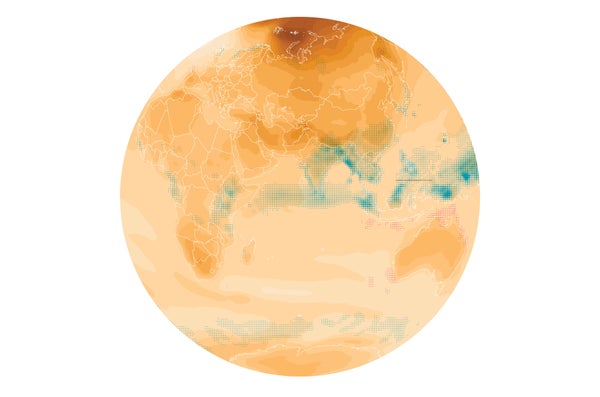
No one knows whether human consciousness will reside on a computer chip by the end of the century or even if self-driving cars will rule the road. But this much is certain: Earth is going to get hotter. The maps displayed here forecast how much warmer our planet will be in the year 2100 and how precipitation patterns will change. To make the figures, Scientific American worked with earth scientists at the nasa Ames Research Center. The researchers used high-resolution climate models from the Intergovernmental Panel on Climate Change to generate climate data for nearly every point on the planet, for every month of every year, through the end of the century. Our graphic presents a middle-of-the-road emissions scenario—it assumes that the world curbs greenhouse gases by midcentury but that substantial warming still takes place.

An estimated 10 billion people will inhabit that warmer world. Some will become climate refugees—moving away from areas where unbearable temperatures are the norm and where rising water has claimed homes. In most cases, however, policy experts foresee relatively small movement within a country's borders. Most people—and communities, cities and nations—will adapt in place. We have highlighted roughly a dozen hotspots where climate change will disrupt humanity's living conditions and livelihoods, along with the strategies those communities are adopting to prepare for such a future.

Click or tap to enlarge


On supporting science journalism

If you're enjoying this article, consider supporting our award-winning journalism by subscribing. By purchasing a subscription you are helping to ensure the future of impactful stories about the discoveries and ideas shaping our world today.


SOURCES: NASA EARTH EXCHANGE GLOBAL DAILY DOWNSCALED PROJECTIONS (NEX-GDDP) (main map and monsoon insets); NOAA OFFICE FOR COASTAL MANAGEMENT (Florida inset); Maps by Katie Peek

SOURCES: NASA EARTH EXCHANGE GLOBAL DAILY DOWNSCALED PROJECTIONS (NEX-GDDP); Maps by Katie Peek

Katie Peek is a science journalist and data-visualization designer with degrees in astrophysics and journalism. She is a contributing artist for Scientific American.

More by Katie Peek
Scientific American Magazine Vol 315 Issue 3This article was published with the title “Coping Skills” in Scientific American Magazine Vol. 315 No. 3 (), p. 38
doi:10.1038/scientificamerican0916-38

Subscribe to Support Independent Journalism

Great science journalism requires human expertise, time, effort and creativity. And it costs money. That’s why I and the journalists here at Scientific American hope you’ll join our community.

When you subscribe, you are supporting staff and freelance journalists who are passionate about telling science stories that are true, important and compelling. Our editors and reporters are often experts in their fields, which means they understand the nuances of big discoveries and can untangle the breakthroughs from the hype. With a subscription, you are also supporting rigorous fact-checking to ensure the words we publish are precise and accurate. And you’re supporting original illustrations, graphics and photos that bring you closer to an advanced laboratory, an ice sheet in Antarctica or a space mission in orbit. You’re helping us craft other types of high-quality journalism as well: Our newsletters are carefully written, edited and curated by staffers you have or will come to know and love. Our Science Quickly podcast is based on original reporting, collaboration with editors and scientists and exacting production.

Subscriptions keep this engine running so we can continue to deliver thoughtful, rigorous and independent science journalism to you. In an era of viral misinformation, this work is crucial. If you value what we do, I hope you’ll consider joining us as a subscriber

Thank you,

Jeanna Bryner, Editor in Chief, Scientific American

Subscribe