
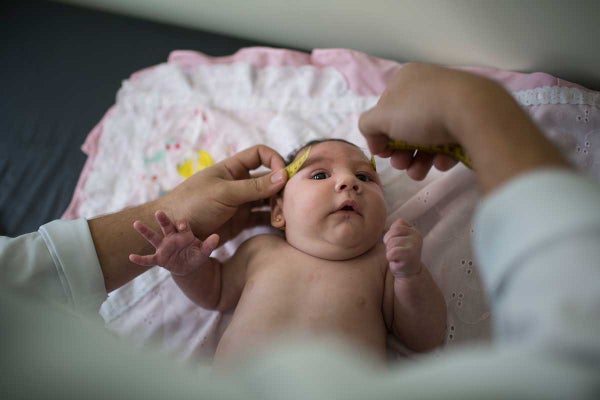
Zika virus has been grabbing headlines because of its links to an alarming birth defect called microcephaly. The data to provide evidence linking the relatively mild mosquito-borne disease and babies born with small heads and potential brain damage, however, are not yet conclusive. World Health Organization and U.S. government officials today discussed this data gap today in a series of public comments and press briefings.
A top official from the U.S. Centers for Disease Control and Prevention told reporters today that to firm up the connections between the two conditions researchers must study the documented microcephaly cases, the case history of pregnant women and conduct case-control studies of babies born in affected areas such as Brazil to get further insights. Only then, following careful analyses, can scientists solidify the Zika–microcephaly links and the required preventative steps.
Although the Brazilian government has said there are almost 4,000 cases of microcephaly in the country, only six of the cases have been strongly linked to Zika virus via laboratory testing that confirms genetic material from the virus is present in the infant, Claudio Maierovitch, director of the Department of Communicable Disease Surveillance in Brazil’s Ministry of Health told the WHO today in Geneva. Brazilian officials with assistance from the CDC and other groups are now trying to firm up that data. The director general of WHO, Margaret Chan, however, said that although that causal relationship has not been proved, it is “strongly suspected.” That is due, in part, to other research that has shown the virus is capable of crossing the placental barrier and showing up in amniotic fluid. Retrospective analysis of an earlier outbreak of Zika in French Polynesia also separately suggests that there, too, was an increase in cases of neurological impairment, according to the CDC.
On supporting science journalism
If you're enjoying this article, consider supporting our award-winning journalism by subscribing. By purchasing a subscription you are helping to ensure the future of impactful stories about the discoveries and ideas shaping our world today.
Microcephaly is defined as being born with an abnormally small head, established by measuring the circumference of a baby’s head and comparing it with those of similarly aged babies of the same sex—a definition that is relatively loose, CDC Principal Deputy Director Anne Schuchat told reporters today. Developmental experts from the CDC, Brazil and elsewhere plan to scrutinize the records of individuals suspected of the abnormality to be certain their conditions were true microcephaly cases, she said.
Another key plank to proving the microcephaly link will be following women during their pregnancy to document what they are exposed to and their future health outcomes, she says. That type of work would require massive resources and logistical coordination and is not yet underway, she says.
Finally, proving these links would require case-control studies that compare microcephalic babies with those born around the same time and area. That type of information, Schuchat says, will provide much-needed nuance about other exposures and factors that could influence the health of these mothers and their offspring.
Even as researchers prepare to launch these further studies, however, families cannot wait to find out how to safeguard themselves and their future offspring. Anthony Fauci, director of the National Institute of Allergy and Infectious Diseases, said today there will not be a vaccine ready to combat Zika for at least several years. So, in the absence of further answers, WHO is stressing that mosquito control in affected areas—helping eradicate mosquitoes and taking precautions to avoid their bites—is the safest course for people living in those regions.