
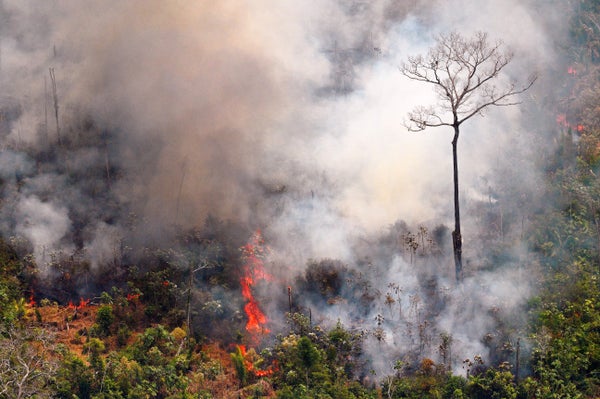
This summer’s fires in the Amazon rain forest in Brazil grabbed the world’s attention. In August, the country’s National Institute for Space Research detected 30,901 fires in the region, almost three times the number seen a year ago. Photographs showed enormous destruction in an ecosystem that is vitally important locally and globally. Now researchers say the problems could be even worse: many trees that are still alive will die during the coming years, and the forest could take thousands of years to regain its current capacity to store carbon.
Large trees that survive a fire in the Amazon die nearly eight times more often than those in unburned sites, and most of them die within an eight-year period following the fire, according to a study published last year in the journal Philosophical Transactions of the Royal Society B. The high fatality rate is because species such as ironwood and Brazilian mahogany in the Amazon did not evolve in a fire-prone environment, so they don’t have thick barks or other resistance mechanisms, says Erika Berenguer, an ecologist at the University of Oxford and a co-author of the study. Fire is a relatively new threat, the result of people burning and clearing parts of the forest to get land for agriculture, or for logging.
“Fires spread very slowly in the Amazon—about 1,000 feet per day. This means they spend a long time at the feet of trees, giving them less chances of survival,” Berenguer says. As these flames burn on, smaller and thinner trees, such as the embauba, die first because of their physical fragility. Larger trees with more dense wood, such as massaranduba, can endure a little longer. But ultimately, they, too, succumb because of damage to two key tree components: vascular tissues called xylem and phloem. “The malfunction of xylem makes it harder for the tree to absorb water. And the failure of phloem hinders the flow of sap, depriving this tree of sugar,” Berenguer explains.
On supporting science journalism
If you're enjoying this article, consider supporting our award-winning journalism by subscribing. By purchasing a subscription you are helping to ensure the future of impactful stories about the discoveries and ideas shaping our world today.
Other species of trees that evolved for millions of years in areas that have long had fires, such as open and dry savannah in Brazil and Africa, grow thicker barks that insulate their inner tissues, according to Rogério Gribel, a biodiversity researcher at Brazil’s National Institute of Amazonian Research. But trees that developed in the dense Amazon, where fires used to be rare and small, never needed such traits to survive. “Their barks are fairly thin—some species have barks that are thinner than a sheet of paper,'” Berenguer says.
Gribel observes there are a few species in transitional areas between the closely packed Amazon forest and the more open savanna that developed a certain tolerance to occasional natural fire. Those trees form firebreaks, protecting their more vulnerable forest neighbors. “Unfortunately, these areas have been largely occupied and razed in recent decades by cattle ranches and soybean monocultures, so most of these dry forests have disappeared,” he says.
Extensive logging and forest clearing have also created more and more exposed open areas within the forest regions themselves. The edges of each open area become new spots where fire can make incursions into the forest. “It’s like taking a big piece of tapestry and cutting it into smaller pieces,” Berenguer says.
Once hit by fires, many trees that appear to survive the initial blaze die a slow, lingering death. In 2002 a study led by Jos Barlow, now a professor of conservation science at Lancaster University in England, found that more than half of the large trees that survive an Amazon fire end up dying in the following three years. He and his colleagues came to this conclusion after monitoring the survival of trees following fires that took place during the dry 1997–1998 El Niño. The 2018 paper co-authored by Berenguer, which focused on regions that were burned between 1984 and 2016, confirms this trend.
Berenguer’s research also forecasts a slow forest recovery, especially in terms of the region’s ability to store carbon in vegetation. The biggest Amazon trees can store four metric tons (4.4 tons) of carbon dioxide. All of that carbon gets released into the atmosphere when trees are burned and die, fueling climate change. And the second-generation trees that grow in burned sites do not store nearly as much. “Even if another tree can grow fast and can absorb, let’s say, more than two pounds of carbon a year, it would need up to 4,000 years to absorb all the carbon the large tree that came before it had,” Berenguer concludes.
