
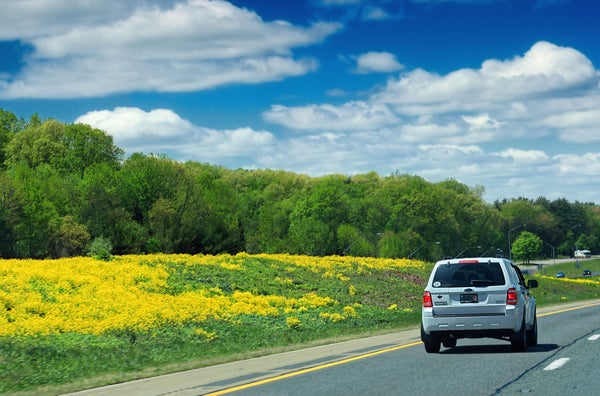
Dear EarthTalk: Why are there stretches of thousands of miles of interstate systems in this country with barren medians? What are the obstacles to planting trees or other vegetation in those areas?— James Logan Cockerham, Middletown, OH
The idea of beautifying highway medians with plantings goes back five decades when Lady Bird Johnson pushed the Highway Beautification Act through Congress in 1965. Today, Americans are starting to think about undeveloped land alongside and between roadways as a low cost and widely dispersed strategy for carbon sequestration. Researchers from the Western Transportation Institute (WTI) at Montana State University report that roadside soils and vegetation on federal lands alone are already capturing almost two percent of total U.S. transportation carbon emissions. WTI adds that the land alongside America’s four million miles of public roadways already maintained by federal, state and local governments could be planted with vegetation optimized for storing atmospheric carbon dioxide and could serve as valuable “banks” for meeting ambitious carbon sequestration goals set at the recent Paris climate accord.
At a talk at 2015’s North American Congress for Conservation Biology in Missoula, Montana, WTI’s Rob Ament reported that shrubs, grasses and other plants already along roads in U.S. national parks, wildlife refuges and other public lands currently are currently sequestering some seven million metric tons of carbon a year—equivalent to taking some five million cars off the road—all without trying to optimize the mix of plants and management practices for carbon storage. Ament advocates that land management authorities and departments of transportation research ways to enlist medians and other public lands in the fight to stave off cataclysmic global warming.
Of course, maintaining highway medians and other forlorn stretches of roadside for carbon sequestration may be more easily said than done, especially since drought across the American West has reduced water budgets for land management and transportation authorities to the bare minimum. While this winter’s El Nino weather pattern has restored many depleted aquifers, water is still likely more valuable than some precious metals and will probably remain scarce for years to come.
On supporting science journalism
If you're enjoying this article, consider supporting our award-winning journalism by subscribing. By purchasing a subscription you are helping to ensure the future of impactful stories about the discoveries and ideas shaping our world today.
Despite the drought, California’s Department of Transportation (Caltrans) is currently looking into just how much carbon sequestration could be possible by optimizing the state’s median and roadside plantings. “Highway roadsides may be an overlooked and undervalued component of the department’s resources available to reduce greenhouse gases and assist in meeting California Air Resources Board compliance goals,” says Doug Brown, a Senior Landscape Architect with Caltrans. “When managed properly, trees are proven cost-effective mitigation measures that sequester carbon.” He adds that increasing tree cover also reduces the heat-island effect by shading impervious surfaces.
Much of the information we already have about vegetation management strategies that optimize carbon sequestration, says Brown, is focused on large tracts of forest land, not on smaller tracts such as along roadsides. He concludes that we need to do much more research to figure out ways to better utilize these roadside green spaces without depleting groundwater reserves. Planting highway medians with carbon-sucking plants may not be the only solution to global warming woes, we need all the help we can get.
CONTACTS: Western Transportation Institute,
www.westerntransportationinstitute.org; North American Congress for Conservation Biology, www.scbnacongress.org; Caltrans, www.dot.ca.gov.
EarthTalk® is produced by Roddy Scheer and Doug Moss and is a registered trademark of Earth Action Network, a 501(c)3 non-profit. For more information, or to make a donation, check out
www.earthtalk.org. Send questions to: question@earthtalk.org.