
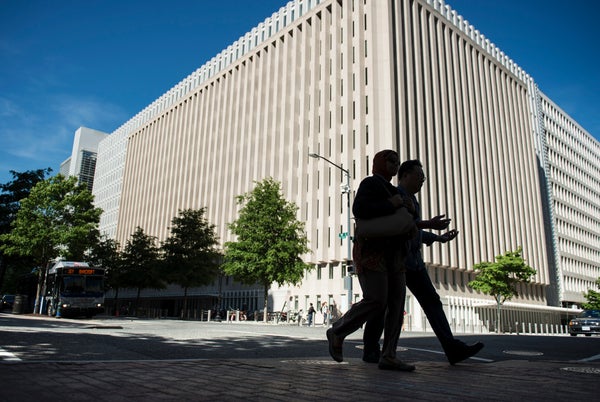
The World Bank Group announced yesterday it plans to mobilize more than $40 billion in clean energy and climate-friendly investments by 2020 and enact a variety of measures to help developing countries meet their international pledges to curb climate change.
The World Bank Group’s Climate Change Action Plan, unveiled yesterday, aims to support the landmark U.N. deal struck in Paris last year by scaling up low-carbon investment and encouraging client countries to do the same while also encouraging nations to put a price on carbon.
“It’s a plan that aims at swinging the pendulum away from investments in fossil fuels toward investments in clean energy, and to put new resources in critical areas like green transport and climate-resistant agriculture,” said John Roome, the bank’s senior director for climate change.
On supporting science journalism
If you're enjoying this article, consider supporting our award-winning journalism by subscribing. By purchasing a subscription you are helping to ensure the future of impactful stories about the discoveries and ideas shaping our world today.
The bank operates in 140 of the 187 countries that submitted so-called nationally determined contributions (NDCs) ahead of the Paris summit pledging to curb emissions after 2020. Many of these nations will send leaders to the New York signing of the deal later this month.
“The important issue after that is to move toward implementation,” said Roome, speaking after yesterday’s meeting of the bank’s board of executive directors.
The climate plan premiered ahead of next week’s annual spring meeting for the World Bank and the International Monetary Fund. The meeting will draw French Sustainable Energy Minister Ségolène Royal, Canadian Environment Minister Catherine McKenna and others to discuss Paris implementation.
World Bank officials said they hope to assist countries in turning their NDCs, now enshrined in the Paris deal, into actionable plans. The bank also promised to take actions of its own to help put the world on track to contain warming.
“Essentially what we’re doing is making climate change a central part of everything we’re doing, building it into our DNA and treating climate change as a critical part of our overall approach to eliminating extreme poverty and improving prosperity,” said Roome, who called this “a fundamental shift for the World Bank.”
‘Deepening efforts’ to price carbon
On curbing emissions, this means “de-risking” green energy investment to add 20 gigawatts of renewable generation over the next five years. The bank will take steps to bring 10 GW of renewable energy onto transmission grids worldwide and make those grids more climate-resilient. It will also invest $1 billion in energy efficiency over the next five years.
The World Bank’s International Finance Corp. will increase its investments with climate co-benefits by half to $3.5 billion by 2020 and will leverage $13 billion annually by the same year.
Separately, the bank aims to mobilize $25 billion in commercial financing for clean energy over the next five years.
Protecting poor countries from the effects of climate change is an even bigger focus, Roome said. “Many of these countries face greater climate risks than wealthier countries,” he said.
Efforts include $2 billion over the next five years to make transportation infrastructure more resilient, create programs for deeply climate-resistant seeds, and help developing countries access meteorological data and early warning systems for planning.
The World Bank and IMF have long supported pricing carbon as a means of signaling a market shift away from carbon-intensive technologies.
Roome said that under the plan, the World Bank would “be deepening our efforts to help countries, both rich and poor, put a price on carbon pollution.”
Carbon prices paired to a rollback in “damaging” fossil fuels subsidies have the potential to redirect trillions of dollars in private investment into low-carbon technologies.
The World Bank has adopted a policy of not supporting coal-fired power plants except under specific conditions, and Roome said no “greenfield” projects are now being considered. The bank is considering support for a coal plant in Kosovo that has long been in its pipeline, but which environmentalists say it should abandon in favor of helping the underdeveloped European country access renewable energy and efficiency (ClimateWire, Jan. 12).
Reprinted from Climatewire with permission from Environment & Energy Publishing, LLC. www.eenews.net, 202-628-6500