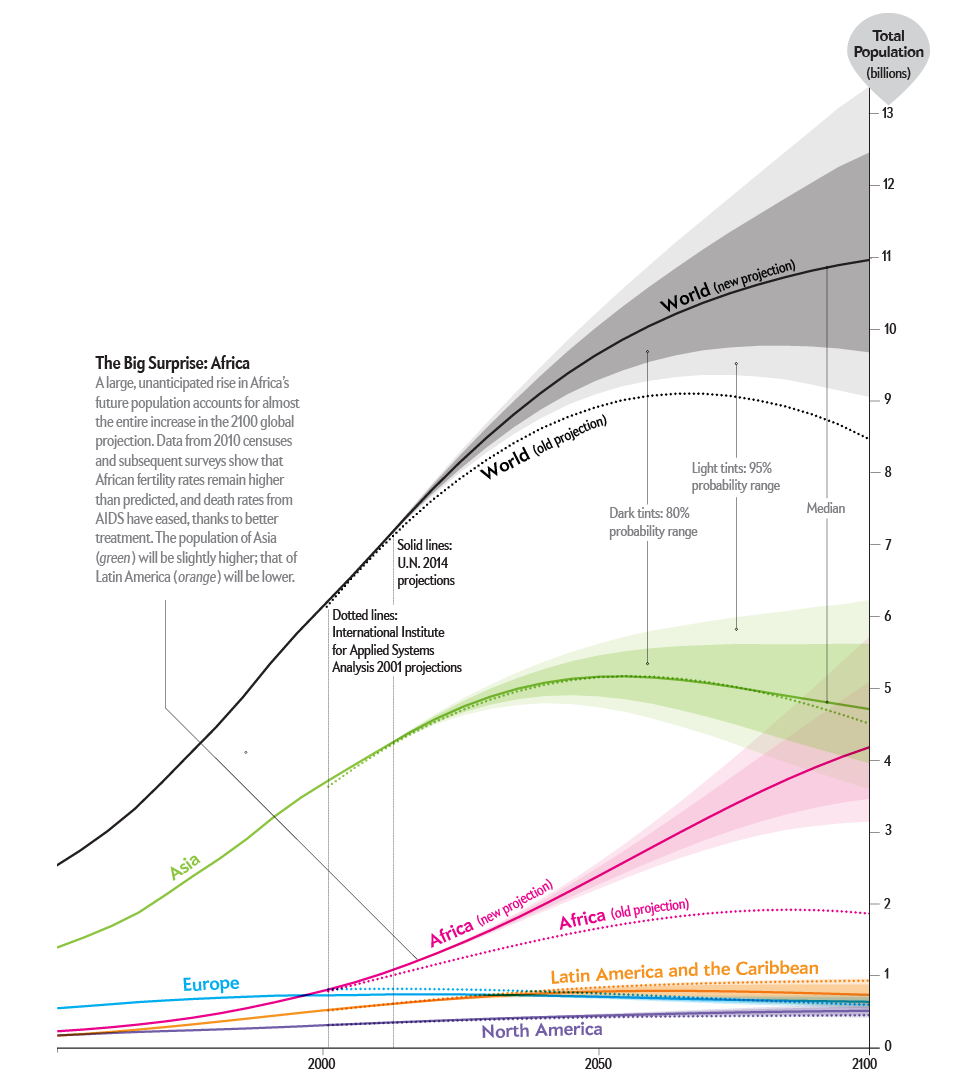
Hana Ševčíková and Jen Christiansen; SOURCES: “WORLD POPULATION STABILIZATION UNLIKELY THIS CENTURY,” BY PATRICK GERLAND ET AL., IN SCIENCE EXPRESS. PUBLISHED ONLINE SEPTEMBER 18, 2014 (2014 projections); “THE END OF WORLD POPULATION GROWTH,” BY WOLFGANG LUTZ ET AL., IN NATURE, VOL. 412; AUGUST 2, 2001 (2001 projections)
United Nations leaders have worried for decades about the pace of population growth. A few years ago leading calculations had global population peaking at nine billion by 2070 and then easing to 8.4 billion by 2100. Currently it stands at 7.2 billion. Recently the U.N. revised these numbers steeply upward: the population is now expected to rise to 9.6 billion by 2050 and continue to 10.9 billion by 2100 (black line, below). What caused this drastic revision? Almost all the increase comes from Africa (pink line). Earlier models “had anticipated that fertility rates in Africa would drop quickly, but they haven’t,” says Adrian Raftery, a statistician at the University of Washington, who assessed the revised estimates. How the world will feed a few billion more people is the question of the day.
On supporting science journalism
If you're enjoying this article, consider supporting our award-winning journalism by subscribing. By purchasing a subscription you are helping to ensure the future of impactful stories about the discoveries and ideas shaping our world today.
If you enjoyed this article, I’d like to ask for your support. Scientific American has served as an advocate for science and industry for 180 years, and right now may be the most critical moment in that two-century history.
SciAm always educates and delights me, and inspires a sense of awe for our vast, beautiful universe. I hope it does that for you, too.
If you subscribe to Scientific American, you help ensure that our coverage is centered on meaningful research and discovery; that we have the resources to report on the decisions that threaten labs across the U.S.; and that we support both budding and working scientists at a time when the value of science itself too often goes unrecognized.