
By Laura Zuckerman
(Reuters) - Yellowstone National Park, which sits atop one of the world's largest super-volcanoes, was struck on Sunday by a magnitude 4.8 earthquake, the biggest recorded there since February 1980, but no damage or injuries were immediately reported.
The tremor, a relatively light event by seismic standards, struck the northwest corner of the park and capped a flurry of smaller quakes at Yellowstone since Thursday, geologists at the University of Utah Seismograph Stations said in a statement.
On supporting science journalism
If you're enjoying this article, consider supporting our award-winning journalism by subscribing. By purchasing a subscription you are helping to ensure the future of impactful stories about the discoveries and ideas shaping our world today.
The latest earthquake struck at 6:34 a.m. near the Norris Geyser Basin and was felt about 23 miles away in two small Montana towns adjacent to year-around entrances to the park - Gardiner and West Yellowstone.
The national park spans 3,472 square miles (8,992 square km) of Wyoming, Montana and Idaho, and draws about 3 million visitors each year to its iconic geysers and wildlife attractions, including bison.
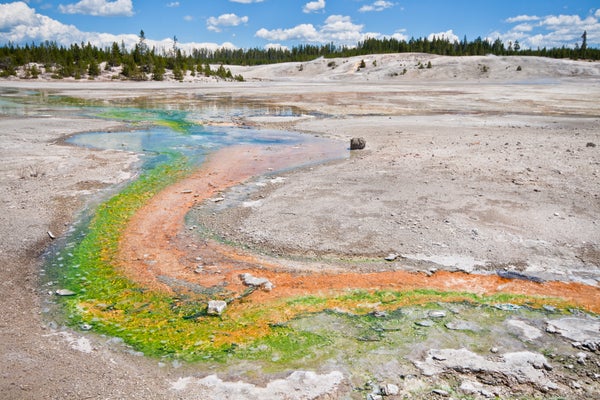
A U.S. Geological Survey team planned to tour the Norris Geyser Basin on Sunday to determine if the quake altered any of Yellowstone's geothermal features, such as geysers, mud pots and hot springs.
Several people reported having felt shaking they compared to the rumble of a tractor-trailer truck driving by, and a few items fell off the shelves at a local grocery store, a West Yellowstone police dispatcher said.
About 1,000 to 3,000 earthquakes strike Yellowstone each year, according to the Yellowstone Volcano Observatory, a research partnership of the park, the University of Utah and the U.S. Geological Survey.
The ancient super-volcano, or caldera, that lies beneath the surface of the park was discovered by scientists in recent years to be 2.5 times larger than previously thought, measured at 30 miles wide, according to the park.
Sunday's quake occurred near the center of an area of ground uplift that geologists have been tracking for several months, University of Utah seismologists said. Elevated seismic activity was also found in the area during a previous period of uplift from 1996 to 2003.
The recent spike in earthquake activity at Yellowstone is linked to the uplift, which in turn is caused by the upward movement of molten rock beneath the Earth's crust, according to the U.S. Geological Survey.
Fortunately, there was no indication that the recent seismic activity signaled an impending eruption of the Yellowstone Caldera, scientists said.
Researchers with the observatory have said in the past that catastrophic eruptions by the super-volcano are unlikely for tens of thousands of years, though less extreme lava releases could occur within thousands of years.
The super-volcano's most cataclysmic eruption occurred 2 million years ago, covering half of North America with ash and killing prehistoric animals as far as away as modern-day Nebraska, according to the Yellowstone Volcano Observatory.
Heat from a vast chamber of molten rock beneath the caldera fuels the park's famous geothermal features, including Old Faithful Geyser, Yellowstone scientists say.
(Reporting by Laura Zuckerman; Editing by Steve Gorman and Sandra Maler)