
The SciencesAugust 25, 2015
Cameras Catch Coyotes as They Take Manhattan [Slide Show]
The Gotham Coyote Project is using cameras, citizen scientists and environmental DNA to study coyotes as they move into New York City, and eventually, Long Island
Cameras Catch Coyotes as They Take Manhattan [Slide Show]
The Gotham Coyote Project is using cameras, citizen scientists and environmental DNA to study coyotes as they move into New York City, and eventually, Long Island
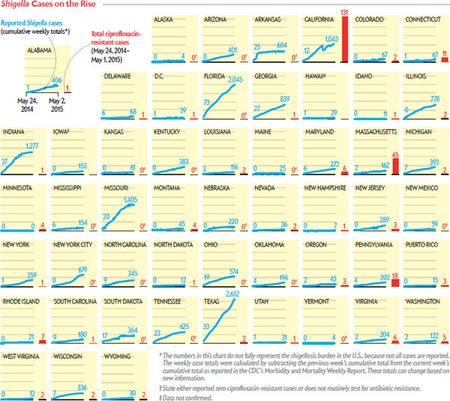
Drug-Resistant Stomach Bug Gains a Foothold in the U.S.
A growing number of Shigella bacteria no longer respond to treatment with the antibiotic ciprofloxacin

Highly Contagious, Antibiotic-Resistant Food Poisoning Establishes U.S. Presence
A Scientific American investigation explores the growing threat from multidrug-resistant shigella in the U.S.
The Opposite Side of the Brain to a Clot Is Key to Stroke Rehabilitation
New drug targets both hemispheres to repair damaged tissue
Can Assisted Reproduction Save the Cheetah? [Slide Show]
The National Zoo is working on ways to make artificial insemination and embryo transfers reliable enough to rebuild genetically stagnant cheetah populations
Does Artificial Food Coloring Contribute to ADHD in Children?
The FDA maintains dyes are safe, but some studies have linked them to hyperactivity in children
Mothers Who Eat a Newborn’s Placenta May or May Not Benefit
Proponents of the practice say it can help relieve postpartum depression, but there are no data to back their assertions
Removal of Ovaries, Fallopian Tubes Wrong Anticancer Option for Most
Angelina Jolie Pitt is part of only a small subset of the population at such high risk for cancer that doctors recommend preventative surgery
Confronting the 2-Body Career Problem [Poll Results]
Scientific American readers share their personal experiences with this enduring dilemma

Satellite View of Spreading Darkness in Syria Reveals Worsening Crisis
The Big Bang Theory's Showrunner Talks Science
The March 12 episode features a mock issue of Scientific American
How Quickly Would Measles Spread if Too Few People Were Vaccinated?
This simulation models what 80 percent vaccination rates of school-age children would look like vs. 95 percent
Road De-Icing Fluids May Contain Unhealthy Chemicals
Some of the salty liquid comes from oil and gas wells, and regulations controlling its contents and use vary widely between states and localities
Alzheimer’s Diagnostic Tests Inch Forward, but Treatments Are Still Lacking
Researchers are trying to develop ways to more quickly and accurately diagnose Alzheimer’s, which might lead to better treatments and understanding in the future
Elective Human Egg Freezing on the Rise
More women are choosing to store their eggs for later pregnancy, a trend that can give women more control over their reproduction
Dating Services Tinker with the Algorithms of Love
How online dating sites and apps hone their software based on user behavior—and misbehavior—to find your true romance
Have You Had a 2-Body Problem? [Poll]
We're asking for your help again this year to find out more about the challenge that couples face when they both seek good jobs in the same city
Stunning Earth Images Tell of Environmental Perils
The environmentally minded musicians in Bella Gaia premiere their debut music video, which includes visualizations from NASA, exclusively on Scientific American
Post-Sandy NYC Subway Brims with Unknown Microbes
The South Ferry station at the tip of Manhattan still resembles an aquatic environment after it flooded during the 2012 storm
NYC Commuter Train Crash Highlights Need for Rethinking Rail Crossings
Safety experts say hundreds of thousands of crossings could be improved. Here’s how