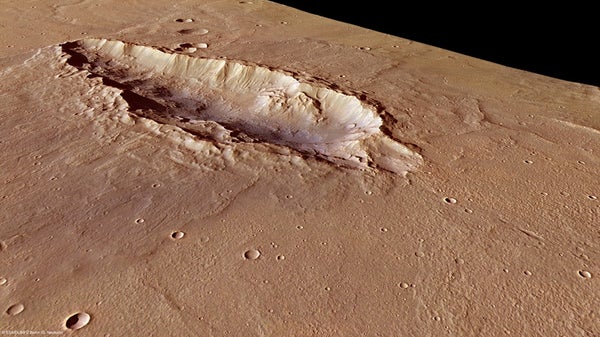
An unusual elongated Martian crater tells tale of a train of impacts
Impact craters are usually round, but the European Space Agency's Mars Express orbiter recently sent back this image of a long, oval crater pocking the Red Planet's southern hemisphere.
ESA/DLR/FU Berlin (G. Neukum)
Join Our Community of Science Lovers!
On supporting science journalism
If you're enjoying this article, consider supporting our award-winning journalism by subscribing. By purchasing a subscription you are helping to ensure the future of impactful stories about the discoveries and ideas shaping our world today.
Impact craters are usually round, but the European Space Agency's Mars Express orbiter recently sent back this image of a long, oval crater pocking the Red Planet's southern hemisphere. What happened here? ESA scientists think a series of impacts created this unusual shape. First, two projectiles—or possibly two halves of one projectile that broke in transit—plowed into this spot at a shallow angle, creating the crater. Deeper areas inside the crater suggest even more projectiles hit afterward.
Spread out in wings around the crater is the "ejecta blanket," which was formed from the material that the projectiles threw aside when they hit. The blanket includes several small channels. Scientists think these features may be evidence that this area of Mars was once covered with material—possibly water—that would have melted or boiled when exposed to the heat from the impacts and then flowed, carving the channels.
–Francie Diep
Subscribe to Support Independent Journalism
Great science journalism requires human expertise, time, effort and creativity. And it costs money. That’s why I and the journalists here at Scientific American hope you’ll join our community.
When you subscribe, you are supporting staff and freelance journalists who are passionate about telling science stories that are true, important and compelling. Our editors and reporters are often experts in their fields, which means they understand the nuances of big discoveries and can untangle the breakthroughs from the hype. With a subscription, you are also supporting rigorous fact-checking to ensure the words we publish are precise and accurate. And you’re supporting original illustrations, graphics and photos that bring you closer to an advanced laboratory, an ice sheet in Antarctica or a space mission in orbit. You’re helping us craft other types of high-quality journalism as well: Our newsletters are carefully written, edited and curated by staffers you have or will come to know and love. Our Science Quickly podcast is based on original reporting, collaboration with editors and scientists and exacting production.
Subscriptions keep this engine running so we can continue to deliver thoughtful, rigorous and independent science journalism to you. In an era of viral misinformation, this work is crucial. If you value what we do, I hope you’ll consider joining us as a subscriber
Thank you,
Jeanna Bryner, Editor in Chief, Scientific American