
On supporting science journalism
If you're enjoying this article, consider supporting our award-winning journalism by subscribing. By purchasing a subscription you are helping to ensure the future of impactful stories about the discoveries and ideas shaping our world today.
As NASA's Curiosity rover rolls across the lonely surface of Mars, it leaves in its tracks a message from home—in Morse code.
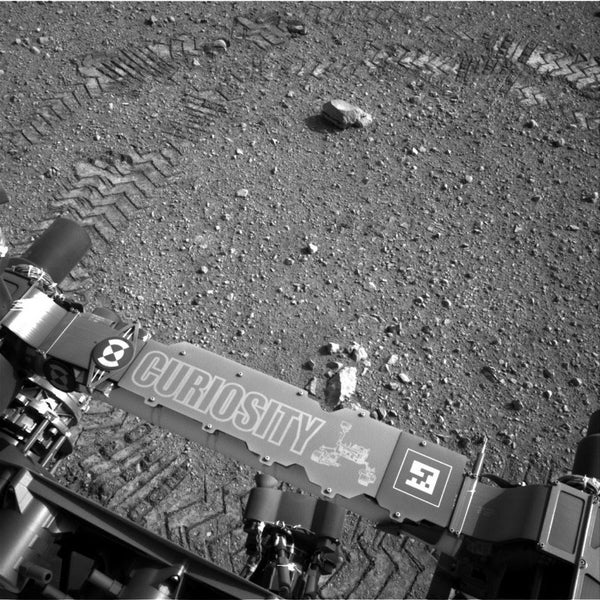
The tracks in the photo above, laid down during Curiosity's first test drive, contain embedded marks that the rover can use as reference points to estimate how far it has traveled. The rover's zigzagging wheel treads are punctuated by straight bands, which leave a telltale mark in the Martian soil on each revolution of the wheel. According to NASA, Curiosity's visual-odometry systems can use those wheel rotations, in the absence of prominent landmarks on the surface, to estimate how far the rover has driven.
The tread bands are not simple straight lines, however. They are embellished with cutouts of different sizes that correspond to the dots and dashes of Morse code. In dot-dash notation, each wheel carries three characters (• – – – / • – – • / • – • •), which spells out "JPL." Those letters, of course, are the acronym of the Jet Propulsion Laboratory in Pasadena, Calif., which manages the rover mission for NASA.