New Issue: Science’s Impossible Questions. Read Now

Spitzer Telescope Sees Baby Stars Blowing Bubbles

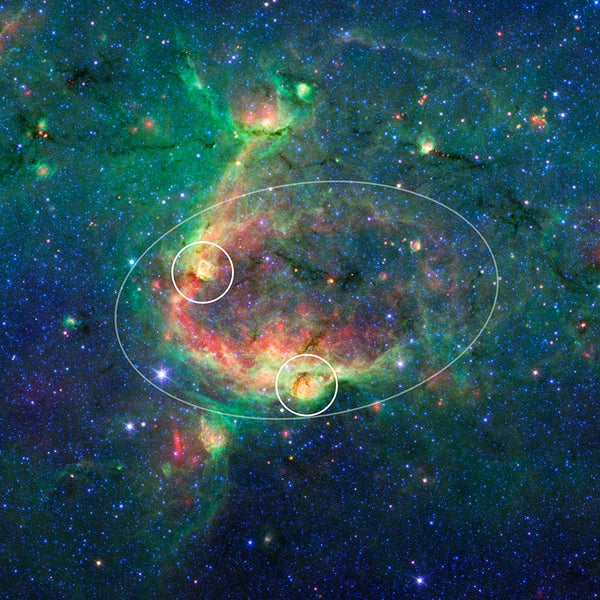
This image from the Spitzer Space Telescope reveals a giant “bubble” in space. Almost 100 light-years across and 15,000 light-years away, the expanding blob is triggering bursts of star formation.

NASA/JPL-Caltech/University of Wisconsin

Join Our Community of Science Lovers!

This image from the Spitzer Space Telescope reveals a giant “bubble” in space. Almost 100 light-years across and 15,000 light-years away, the expanding blob is triggering bursts of star formation.

At the bubble’s core sits a cluster of several dozen blazing young stars. These stars—each dozens of times more massive than the sun—drive fierce winds that carve out a void in the interstellar gas and dust.

As the growing bubble plows through space, it compresses gas. The compression triggers new waves of star formation. All along the bubble’s edge new stars begin to light up. The stellar infants begin blowing bubbles of their own. The smaller bubbles (circled for clarity) appear strung out along the main bubble’s edge.


On supporting science journalism

If you're enjoying this article, consider supporting our award-winning journalism by subscribing. By purchasing a subscription you are helping to ensure the future of impactful stories about the discoveries and ideas shaping our world today.


Images like this give astronomers a rare glimpse into how stars are born. In this case the birth of one star cluster gives rise to the creation of several others. Astronomers call this phenomenon “triggered star formation.” By measuring how quickly the bubbles are expanding, researchers estimate that the main cluster formed sometime within the last million years. The newer sites on the bubble’s edge are probably only a few hundred thousand years old.

The photo is part of GLIMPSE (Galactic Legacy Infrared Mid-Plane Survey Extraordinaire)—a program that uses infrared light to map our galaxy’s disk. The infrared Spitzer telescope can penetrate the thick, dark dust lanes that normally block our view in this part of the galaxy thus allowing astronomers to study distant stellar nurseries in great detail.

Christopher Crockett

Subscribe to Support Independent Journalism

Great science journalism requires human expertise, time, effort and creativity. And it costs money. That’s why I and the journalists here at Scientific American hope you’ll join our community.

When you subscribe, you are supporting staff and freelance journalists who are passionate about telling science stories that are true, important and compelling. Our editors and reporters are often experts in their fields, which means they understand the nuances of big discoveries and can untangle the breakthroughs from the hype. With a subscription, you are also supporting rigorous fact-checking to ensure the words we publish are precise and accurate. And you’re supporting original illustrations, graphics and photos that bring you closer to an advanced laboratory, an ice sheet in Antarctica or a space mission in orbit. You’re helping us craft other types of high-quality journalism as well: Our newsletters are carefully written, edited and curated by staffers you have or will come to know and love. Our Science Quickly podcast is based on original reporting, collaboration with editors and scientists and exacting production.

Subscriptions keep this engine running so we can continue to deliver thoughtful, rigorous and independent science journalism to you. In an era of viral misinformation, this work is crucial. If you value what we do, I hope you’ll consider joining us as a subscriber

Thank you,

Jeanna Bryner, Editor in Chief, Scientific American

Subscribe