
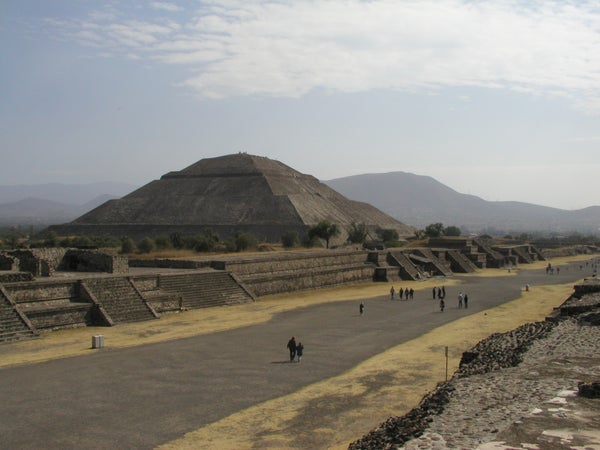

As humans developed civilizations in Eurasia and Northern Africa, they also domesticated animals for food and labor: horses, cows, goats, pigs, sheep and a few others. But no evidence existed for the deliberate cultivation and breeding of animals in North or Central America—until now.
“So at this ancient city of Teotihuacan in particular, which is really one of the earliest urban cities in North America…”
Andrew Somerville of the University of California San Diego, talking about the metropolis that once existed some 30 miles northeast of present-day Mexico City.
On supporting science journalism
If you're enjoying this article, consider supporting our award-winning journalism by subscribing. By purchasing a subscription you are helping to ensure the future of impactful stories about the discoveries and ideas shaping our world today.
“…previous excavations have found a lot of rabbits. But at one compound in particular they found more evidence that they were interacting with rabbits more intensively. There was a statue of a rabbit. There was evidence that maybe they were butchering them. And this compound, which is called Oztoyahualco, actually had almost twice as many rabbit bones relative to the other complexes at the city. So it did seem like something was different with this particular compound.”
Somerville and colleagues tested 134 rabbit bones at the 2,000-year-old site, as well as 13 contemporary samples. If the ancient rabbits fed on wild vegetation, the carbon isotopes in the bones would show evidence of what’s known as the C3 photosynthetic pathway. But the domesticated crops of that time, such as corn and cactus fruit, employ what’s called the C4 pathway—which leaves a different carbon isotope ratio in the bones.
“Fortunately we were able to actually show that rabbits from this compound did actually have higher carbon values, significantly higher carbon values. Which means that they did have significantly different diets from other rabbits within the city, and also significantly different diets than wild rabbits from around the region. Which is pretty strong evidence we say to show that they were actually being provisioned by humans, fed by humans, managed by humans.”
The research is in the journal PLoS ONE. [Andrew D. Somerville et al, Animal Management at the Ancient Metropolis of Teotihuacan, Mexico: Stable Isotope Analysis of Leporid (Cottontail and Jackrabbit) Bone Mineral]
It’s true that the carbon evidence could also be the result of the rabbits being trapped in corn fields, where they were scavenging. But the presence of the dedicated pen and the statue of a rabbit led the scientists to conclude that the animals were in fact being raised—which changes our understanding of New World cities.
“That is one of these assumptions about the new world—that they just didn't have as intensive relationships with animals. That husbandry, especially with mammals, wasn't as important of a factor in their organization and supporting these big cities. So what we're showing is that maybe they were just as intensive in some respects as these old world cities but they’re just less archaeologically visible. A rabbit leaves a much smaller footprint than a cow or a horse does.”
—Cynthia Graber
[The above text is a transcript of this podcast.]

