
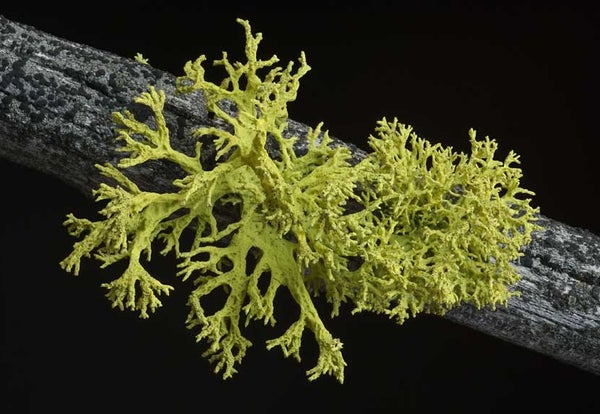

Lichens. They’re probably the most common example of two organisms living in a symbiotic relationship. There’s a fungus and a photosynthesizing partner, like algae. It's a bond that was born, as they say, when "Alice Algae," took a "lichen" to "Freddie Fungus."
But that simple description covered up a larger mystery: how could two different lichen species combine the same building blocks—same fungus, same algae—“and yet they look very different, have very different chemistry, and some of them even have distinctly different ecology."
Toby Spribille, an evolutionary biologist at the University of Montana, and the University of Graz in Austria.
On supporting science journalism
If you're enjoying this article, consider supporting our award-winning journalism by subscribing. By purchasing a subscription you are helping to ensure the future of impactful stories about the discoveries and ideas shaping our world today.
He and his colleagues studied two lichen species that fit that bill. Same underlying parts, different color and chemistry. They ground the lichens up, and then analyzed their RNA. What they expected to find was two genomes: one fungus, one alga. "And what we found was, at the end of a lot of analysis, what we had was three genomes, not two."
The third genome was from a type of yeast. And the more yeast was present, the more yellowish—and more toxic—the lichen was. The study appears in the journal Science. [Toby Spribille et al., Basidiomycete yeasts in the cortex of ascomycete macrolichens]
But how could scientists spend so many years studying these lichens—and still miss this crucial third species? Spribille says it could have been the type of genetic sequencing. Previous studies relied on DNA barcodes, which only sample some of the genome, to identify the underlying fungus and alga. Sort of like identifying the occupants of a completely dark room by shouting out a few names and seeing who answers.
What Spribille did, instead, was just turn all the lights on, with whole genome sequencing, revealing the identity of all occupants, and in doing so, "we eliminated anything that required going in and calling out somebody's name so to speak."
As for whether some lichens might have four, five species? "I certainly wouldn't rule it out at this point." Because this study indicates lichens are truly more than the sum of their parts. Including, of course, the parts we still don't know about.
—Christopher Intagliata
[The above text is a transcript of this podcast.]
