
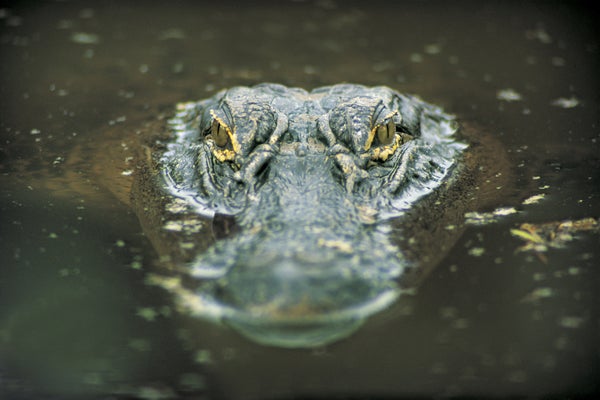

Florida’s Everglades are home to lots of large wading birds, like egrets and herons. But the ‘Glades also have lots of raccoons and possums. For the mammals, the birds’ nests are an all-you-can-eat buffet. And when an invasion occurs, "sometimes thousands of birds will abandon their nests, and just leave, and there's littered remains of dead chicks and eggs that have been eaten." Lucas Nell, an ecologist at the University of Georgia.
Nell says that, in order to seek protection from their furry foes, birds actually prefer to build their nests in plots of swamp with a resident alligator. In fact, in one study a graduate student planted fake alligators. And the birds seemed to prefer to build nests close to them. "Where there's a water source, there are alligators, so it's sort of this moat of protection around these colonies."
Nell and his colleagues took to the Everglades at night, hunting for gators near and far from nests. "You have to use a spotlight and you see the little demon eyes shining out of the marsh." They lassoed the gators, pulled them into the airboat, and took blood samples and body measurements.
On supporting science journalism
If you're enjoying this article, consider supporting our award-winning journalism by subscribing. By purchasing a subscription you are helping to ensure the future of impactful stories about the discoveries and ideas shaping our world today.
Turns out the gators near bird colonies were 13 percent fatter. Which means this unusual arrangement may be mutually beneficial. The birds get protection. And the alligators? They feast on any chicks that get kicked out of the nest, as well as on the rest of the extra-productive swamp life, fertilized by all that guano. The findings are in the journal PLoS ONE. [Lucas A. Nell et al, Presence of Breeding Birds Improves Body Condition for a Crocodilian Nest Protector]
There is one drawback for adult birds who stray too close to their bodyguard: Gators are not discriminating diners. "I liken it less to a bodyguard situation, more like keeping some psychopathic murderer in your yard, to keep out cat burglars."
—Christopher Intagliata
[The above text is a transcript of this podcast.]

