
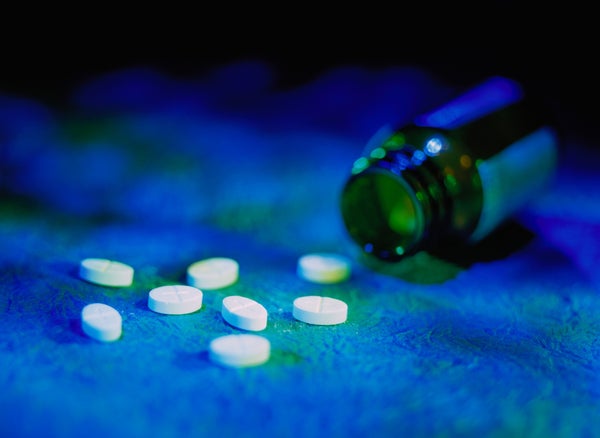

“We’ve been dealing with an epidemic in the United States related to opioids.”
Wilson Compton, deputy director of the National Institute on Drug Abuse of the National Institutes of Health. He spoke February 12th at the annual meeting of the American Association for the Advancement of Science in Washington, D.C.
“What we’ve seen is that the increased number of prescriptions are driving the nonmedical use of prescription drugs.”
On supporting science journalism
If you're enjoying this article, consider supporting our award-winning journalism by subscribing. By purchasing a subscription you are helping to ensure the future of impactful stories about the discoveries and ideas shaping our world today.
Drugs that are prescribed to treat pain.
“So there’s tremendous availability of prescriptions. There are some 260 million prescriptions written in each year for opioids. That’s not tablets, that’s prescriptions. So it’s millions and millions of these and some of them are available for diversion and use inappropriately.”
Some of the pain patients may become hooked. Or their meds may find their way to friends or relatives who take them recreationally. Or a prescription opioid user may transition to heroin.
“Heroin is just another opioid drug, so the brain doesn’t distinguish whether it comes from a pharmacy or from a street drug dealer....
“What’s been drawing the most public health attention is the overdose death rates related to prescription opioids and heroin, which have increased markedly over the last 15 years. Right now we see drug overdoses killing nearly 50,000 persons in a given year in the United States….”
“What are we doing about this? We’ve focusing in three areas. We need to think about prevention in terms of reducing access to prescriptions as the ultimate upstream driver of this epidemic. We need to be thinking in terms of saving lives acutely by providing greater access to the reversing drug—this is naloxone--that blocks the impact. So if somebody’s overdosed and they’re not breathing and I can get this medication to them quickly, I can resuscitate them. That gives us a chance to help them turn their lives around with the third aspect, which is greater access to effective treatment, through medication-assisted treatment….
“But we also think we need to come up with better approaches for treating pain. What are non-medical approaches that might use brain stimulation techniques, for example, to treat pain? What are other medications that don’t include the opioid system that might be useful? … These are the kinds of advances that science can bring us so that we can turn around this overdose epidemic that right now shows tremendous increases each year.”
—Steve Mirsky
[The above text is a transcript of this podcast.]
