
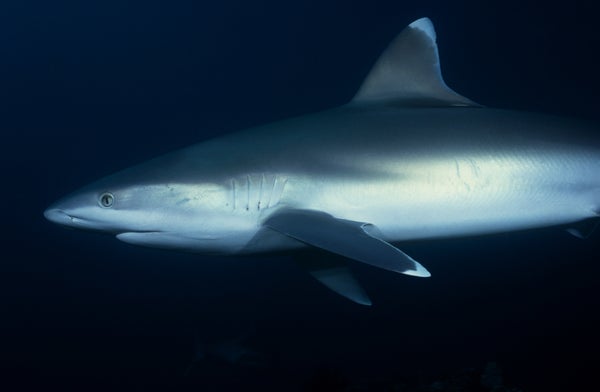

Living at the top of the food chain, sharks can accumulate dangerous levels of methylmercury. So much that pregnant women and children are advised not to eat shark at all. But sharks can accumulate another toxin too, called BMAA, which has been linked to the development of neurodegenerative disease. Which could be bad news for shark eaters.
"Mercury in combination with BMAA is a one-two punch." Deborah Mash, a professor of neurology at the University of Miami's Miller School of Medicine. "These are two synergistic toxins. So even if there are low levels of exposure from the mercury or the BMAA, when humans are exposed to both of these toxins, then they will have a synergistic effect on the nervous system."
BMAA starts out in cyanobacteria, and travels up the food chain through crabs and shrimp and fish. And, as previous studies have shown, all the way to sharks. What Mash and her colleagues wanted to know was how widespread the problem was, and if the chemical often appeared alongside mercury. So they analyzed fin and muscle samples from 10 species of shark—55 individuals in all—from the Atlantic and Pacific Oceans. And they found BMAA and mercury in all 10 species. Suggesting that exposure to that "one-two punch" could be pretty common. The results are in the journal Toxins. [Neil Hammerschlag et al., Cyanobacterial Neurotoxin BMAA and Mercury in Sharks]
On supporting science journalism
If you're enjoying this article, consider supporting our award-winning journalism by subscribing. By purchasing a subscription you are helping to ensure the future of impactful stories about the discoveries and ideas shaping our world today.
It's still not clear at this point what sort of risk this occasional exposure through food might have. Still, Mash isn't waiting.
"I myself would not want to be exposed to BMAA or methyl mercury in my diet by eating shark fin or shark meat or taking shark cartilage products. We already know that mercury is toxic to our health. And we already know that BMAA plus mercury is a very bad mix for the brain. So people need to be concerned, and I think that's not only for the benefit of us as consumers, but also to the poor sharks, who are threatened with extinction."
Conservationists have argued for years that sharks should be spared. Maybe now that it's us who are threatened... people might finally start to leave them alone.
—Christopher Intagliata
[The above text is a transcript of this podcast.]

