
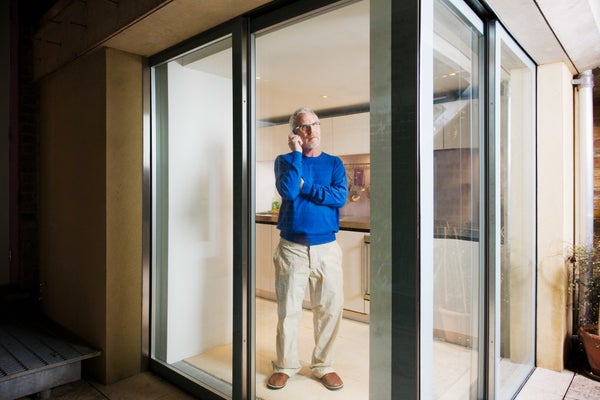

There's a scene in Bladerunner, Ridley Scott's sci-fi classic, when Harrison Ford's character, Deckard, is about to interview Rachael, played by Sean Young, to test whether she's a real human—or a replicant. ["It's too bright in here."] On cue, the floor-to-ceiling windows dim, shading the room from the golden sunlight outside.
It was a beautiful Hollywood effect when the movie came out in 1982. And now it may not be that far from reality. Because researchers at Harvard recently designed a material that, with a shot of electricity, can transform a glass window from transparent to opaque in less than a second.
The team built the window by sandwiching glass between two sheets of a transparent, balloon-like rubber material, laced with silver nanowires. As is, the material is clear. But apply voltage, and the nanowires are attracted to each other ever so slightly across the glass—which deforms those rubbery sheets just enough to scatter light, causing the glass to cloud up. They describe the device in the journal Optics Letters. [Samuel Shian and David R. Clarke, Electrically tunable window device]
On supporting science journalism
If you're enjoying this article, consider supporting our award-winning journalism by subscribing. By purchasing a subscription you are helping to ensure the future of impactful stories about the discoveries and ideas shaping our world today.
Study author Samuel Shian, a materials scientist, says this smart glass is cheaper than others, and uses minimal power—much less, for example, than something like a curling iron. And, since it's flexible and foldable, he says it could even be used for things like camouflage uniforms, to switch, for example, from green and brown to white and gray. "This would be very useful when the background landscape suddenly changes, such as during early snowfall."
Bladerunner was set in Los Angeles in 2019. Meaning Shian and others still have about three years to turn one bit of science fiction into science fact.
—Christopher Intagliata
[The above text is a transcript of this podcast.]
