
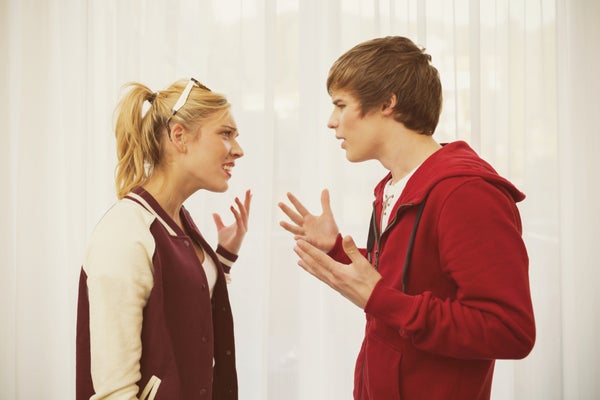

Watch your tone—because it turns out it really isn’t what you say—it's how you say it. At least when it comes to couples in couples counseling.
That’s according to a study in Proceedings of Interspeech. [Md Nasir et al., Still Together?: The Role of Acoustic Features in Predicting Marital Outcome]
Researchers developed a computer algorithm to gauge relationships between spouses based on their vocal patterns. Working with hundreds of recorded conversations from marriage therapy sessions collected over two years, the algorithm was able to predict whether a relationship was going to get better or worse with an accuracy of just under eighty percent.
On supporting science journalism
If you're enjoying this article, consider supporting our award-winning journalism by subscribing. By purchasing a subscription you are helping to ensure the future of impactful stories about the discoveries and ideas shaping our world today.
How they did it? The recordings were divided by acoustic features that used speech processing techniques to track pitch and voice warble and intensity.
These clips from the researcher’s training video illustrate psychological states that characterize distressed relationships. This one, for example, shows “negative affect” and “reactivity” – behaviors that relationship experts believe are troublesome.
Female: And I want you to just come home at a more reasonable time rather than you know walking in the door at 11. Male: I just don’t think you understand just how much I have to do, what my work entails. Female: Well, what is there to understand?
The counseling sessions were also tested against behavioral analyses with codes for positives such as “acceptance” and the negatives such as “blame.” Using only that more standardized research method wasn’t as predictable as listening to the vocal expressions.
Now, these examples are negative as the researchers focused on distressed relationship dynamics. One could imagine the algorithms may also work the same way when looking at positive vocal patterns. Because even married couples sometimes say nice things to each other.
—Erika Beras
[The above text is a transcript of this podcast.]
