New Issue: Orbital Catastrophe Ahead? Read Now

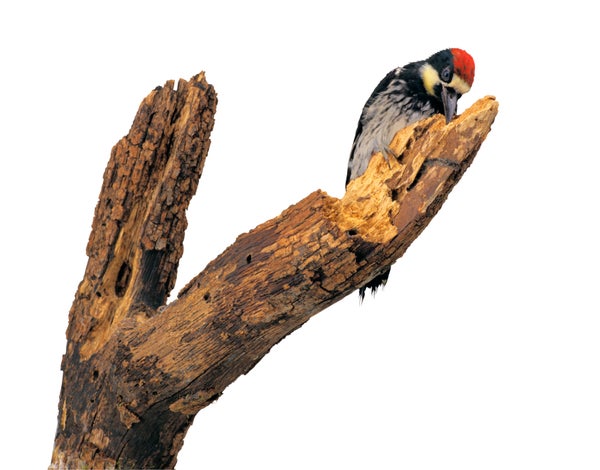
Woodpecker Head Bangs Communicate Info

Woodpeckers that listen to others of their kind drum into trees alter their behavior based on what they hear.   


GETTY (MARS)

Illustration of a Bohr atom model spinning around the words Science Quickly with various science and medicine related icons around the text

Join Our Community of Science Lovers!

[Pretty bird song]

Some birds produce beautiful songs.

[Woodpecker drumming]


On supporting science journalism

If you're enjoying this article, consider supporting our award-winning journalism by subscribing. By purchasing a subscription you are helping to ensure the future of impactful stories about the discoveries and ideas shaping our world today.


Woodpeckers are not among them. The most familiar sound they make is when they tap on tree trunks with their bills to produce what’s called “drumming."

"This drumming that they show is essentially them kind of slamming their head against a tree at remarkable speeds.” Wake Forest University biologist Matthew Fuxjager.

“Some of the woodpeckers will use this kind of drumming-type maneuvering to excavate a nest, they'll make little caches in a tree to store food, or some of them will actually forage that way. But then they also use it for this social signal."

Fuxjager’s team broadcast the pre-recorded sounds of head slams to mated pairs of downy woodpeckers in the woods nearby. They discovered that there's a lot of information communicated in the drumming.

For example, woodpeckers that produce shorter drums are probably kind of wimpy, and easy to beat in a fight. But if a drum is longer, the challenger might be advertising itself as a stronger, tougher bird, one that's a bit harder to fend off.

And after hearing recordings of long drums, pairs of birds begin to coordinate the defense of their territory. They don’t bother with such behavior after short drums. [Eric R. Schuppe, Gloria D. Sanin and Matthew J. Fuxjager, The social context of a territorial dispute differentially influences the way individuals in breeding pairs coordinate their aggressive tactics, in Behavioral Ecology and Sociobiology]

The researchers think that this kind of coordination might have evolved because woodpeckers invest so much time and energy carving out their nest hole in a tree. If they were kicked out and had to start over, they might not get a chance to reproduce and fledge their offspring. By responding only to more realistic threats, woodpecker pairs can conserve energy to be expended at the hard work of raising their headstrong chicks.

—Jason G. Goldman

[The above text is a transcript of this podcast.]


Jason G. Goldman is a science journalist based in Los Angeles. He has written about animal behavior, wildlife biology, conservation, and ecology for Scientific American, Los Angeles magazine, the Washington Post, the Guardian, the BBC, Conservation magazine, and elsewhere. He contributes to Scientific American's "60-Second Science" podcast, and is co-editor of Science Blogging: The Essential Guide (Yale University Press). He enjoys sharing his wildlife knowledge on television and on the radio, and often speaks to the public about wildlife and science communication.

More by Jason G. Goldman

Subscribe to Support Independent Journalism

Great science journalism requires human expertise, time, effort and creativity. And it costs money. That’s why I and the journalists here at Scientific American hope you’ll join our community.

When you subscribe, you are supporting staff and freelance journalists who are passionate about telling science stories that are true, important and compelling. Our editors and reporters are often experts in their fields, which means they understand the nuances of big discoveries and can untangle the breakthroughs from the hype. With a subscription, you are also supporting rigorous fact-checking to ensure the words we publish are precise and accurate. And you’re supporting original illustrations, graphics and photos that bring you closer to an advanced laboratory, an ice sheet in Antarctica or a space mission in orbit. You’re helping us craft other types of high-quality journalism as well: Our newsletters are carefully written, edited and curated by staffers you have or will come to know and love. Our Science Quickly podcast is based on original reporting, collaboration with editors and scientists and exacting production.

Subscriptions keep this engine running so we can continue to deliver thoughtful, rigorous and independent science journalism to you. In an era of viral misinformation, this work is crucial. If you value what we do, I hope you’ll consider joining us as a subscriber

Thank you,

Jeanna Bryner, Editor in Chief, Scientific American

Subscribe