
Key concepts
Chemistry
Physics
Materials science
Carbonation
Physical reactions
Explosions
Introduction
On supporting science journalism
If you're enjoying this article, consider supporting our award-winning journalism by subscribing. By purchasing a subscription you are helping to ensure the future of impactful stories about the discoveries and ideas shaping our world today.
Have you ever seen the Diet Coke and Mentos experiment that is all over the Internet and wondered what makes the reaction work? You might think that there is some ingredient in a Mentos candy that causes a chemical reaction with the soda pop, like the way baking soda reacts with vinegar. But the amazing eruption that takes place when Mentos are dropped into Diet Coke or other brands of diet soda pop is not a chemical reaction at all! Instead it is a physical reaction. That means that all of the pieces of the reaction are there, but that they are simply rearranged. It also means changing some factors may cause a larger or smaller physical reaction to take place.
Background
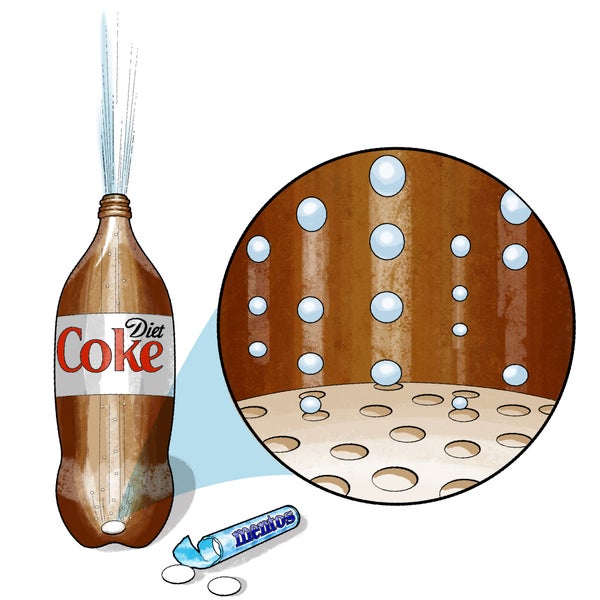
A carbonated beverage is packed full of dissolved carbon dioxide gas, which forms bonds with water. While the soda is in the bottle, the gas is kept in solution by the bottle's pressurized conditions. When you pour some soda into a glass, some gas escapes and forms foam, but most stays trapped by the surface tension of the water. But all those gas bubbles want to escape, making it no wonder that soda makes you burp!
To create bubbles, the carbon dioxide needs to interact with itself, which means that the carbon dioxide's bonds with water in the Diet Coke must be broken. A Mentos candy can help with this. Although the candy may look smooth, if you looked at it under a microscope you'd see tiny bumps coating its entire surface. This rough surface allows the bonds between the carbon dioxide gas and the water to more easily break, helping to create carbon dioxide bubbles and cause the classic eruption. The speed at which the Mentos falls through the soda can affect how large the eruption is, and this can be tested by comparing whole with crushed Mentos, the latter of which are less dense.
Materials
Wax paper
Cutting board
Knife
One roll of Mentos (at least eight candies)
Two index cards
Tape
Two two-liter bottles of Diet Coke
An outdoor area at least two meters from buildings
Eye protection (safety goggles or glasses)
Video camera with either a tripod or a helper to take the images (optional)
Preparation
Place a piece of wax paper on top of the cutting board. On the wax paper, carefully use a knife to crush and cut four Mentos candies into many small pieces. An adult may help you cut up the candies. What does the inside of the candies look like?
Make a Mentos cartridge to hold the candies for you before you drop them into the Diet Coke bottle by rolling an index card into a tube, slightly larger than the diameter of a Mentos candy. Tape the tube together on the side.
Be sure to wear eye protection when putting the candies into the cola!
Wear clothes that you would not mind if they get splashed with a little soda pop—this activity can get a little messy!
Procedure
Place a Diet Coke bottle in an outdoor area, at least two meters from any buildings or anything hanging above the area, such as eaves, overhangs or wires. Make sure that the bottle is on a level surface and stably standing straight. Why do you think all of this is important?
If you want to videotape the reactions, set up the video camera so that it has in its viewfinder the bottle and a height equivalent to at least the first story of a building.
Carefully remove the cap from the bottle and place the flat index card on top, covering the hole.
Add four whole Mentos candies to your cartridge, put on your eye protection, and start the video camera.
Place your full cartridge on top of the flat index card. Line up where the opening of the bottle is with the opening of your cartridge. Quickly pull out the flat index card, releasing the Mentos candies into the bottle. Then step back without tipping the bottle over or disturbing the reaction.
How quickly did the reaction start to happen, and how quickly did it stop? About how high did the eruption go? How much cola is left in the bottle?
When the bottle stops spouting, stop recording.
Remove the spent cola bottle and place a new full bottle in the same position, again making sure that it is level and stably standing straight. As with the first bottle, remove the cap and place the flat index card on top, covering the hole.
Add your four crushed Mentos candies to your cartridge, pouring them in from the wax paper. Put on your eye protection and start the video camera.
Like you did before, place your full cartridge on top of the flat index card, then line up where the opening of the bottle is with the opening of your cartridge. Quickly pull out the flat index card, releasing the crushed Mentos into the bottle, then step back without tipping the bottle over or disturbing the reaction.
How quickly did the reaction start to happen, and how quickly did it stop? How high did the eruption appear to go? How much liquid is left in the bottle? Is it more or less than the amount that was left when you used whole candies?
When the bottle stops spouting, stop recording. If you videotaped the reactions, you can watch your videos now. What do you notice from the videos?
Which reaction went higher, the whole or the crushed Mentos?
Extra: Find an exterior wall of a building with no windows and set a Diet Coke bottle at the base of the wall. Use a tape measure and blue painter's tape to mark off the height from the top of the bottle in meters. Then repeat this activity three times, with the bottle in front of the tape-marked wall, video taping it each time. When you review the recordings, use slow motion and pause the recording when the spout is at its maximum height. Using the tape marks in the background, estimate the height of the spout. Calculate the average height of the fountains for the whole and for the crushed Mentos. What is the difference in height of the eruptions?
Extra: What other factors affect the size of the Mentos and Diet Coke eruption? You can try testing different kinds of carbonated beverages, different kinds of candies with different shapes and textures or using other things to start the reaction, like rock salt, pennies or dice. Which beverages, candies or other things cause the largest and smallest fountains? Why do you think this is?
Extra: Do this activity again but instead of testing whole Mentos versus crushed, compare warm versus cold Diet Coke. Does temperature affect the eruption height?
Observations and results
Was the eruption higher when whole Mentos candies were used compared with crushed candies? Was less Diet Coke left in the bottle after the reaction with the whole candies compared with the crushed ones?
In the Diet Coke bottle the Mentos candy provides a rough surface that allows the bonds between the carbon dioxide gas and water to break more easily, helping to create carbon dioxide bubbles. As the Mentos candy sinks in the bottle, the candy causes the production of more and more carbon dioxide bubbles, and the rising bubbles react with carbon dioxide that is still dissolved in the soda to cause more carbon dioxide to be freed and create even more bubbles, resulting in the eruption. Because Mentos candies are rather dense, they sink rapidly through the liquid, causing a fast, large eruption. The crushed Mentos candies, however, are not as dense as the whole ones, which causes them to sink more slowly, creating a relatively small cola fountain, which should also leave more liquid in the bottle than the larger eruption with whole Mentos candies did.
Cleanup
Hose off any part of a building that was splashed with Diet Coke. If you try this project with regular Coke, the eruption should still happen but its sugary content may make cleaning more difficult.
More to explore
Physicists Explain Mentos–Soda Spray from Scientific American
Science of Mentos–Diet Coke explosions explained from New Scientist
The Science of Coke and Mentos from EepyBird.com
Why do Mentos mints foam when you drop them into soda pop? from General Chemistry Online
Coke® & Mentos®—Nucleation Goes Nuclear! from Science Buddies
This activity brought to you in partnership with Science Buddies
