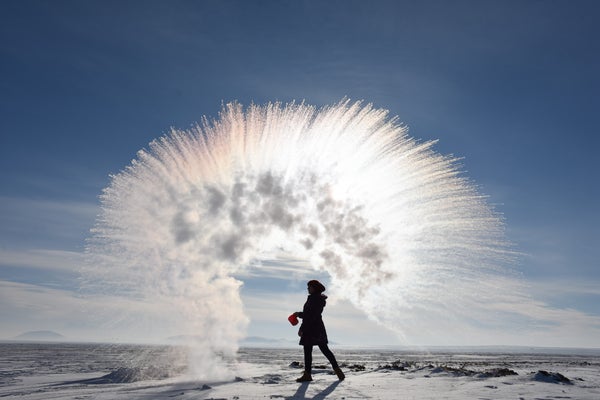
Is it true that hot water freezes faster than cold water or that cold water boils faster than hot water? It seems hard to believe, but some people swear that it is so.


Share on Tumblr

Still feeling skeptical? Fred W. Decker, a meteorologist at Oregon State University in Corvallis, encourages readers to settle the question for themselves:

"You can readily set up an experiment to learn which freezes earlier: water that is initially hot, or water that is initially cold. Use a given setting on an electric hot plate and clock the time between start and boiling for a given pot containing, say, one quart of water; first start with the water as cold as the tap will provide and then repeat it with the hottest water available from that tap. I'd wager the quart of water initially hot will come to a boil in much less time than the quart of water initially cold.

"The freezing experiment is harder to perform, because it ideally requires a walk-in cold storage chamber that is set to a temperature below freezing. Take into the chamber two quart-volume milk bottles filled with water, one from a hot tap and the other from a cold tap outside the chamber. Time them to freezing, and I would wager again that the initially colder water will freeze sooner than the initially hot water."

[We would add that, if you don't want to suffer in a walk-in freezer, you can conduct a reasonably good version of the above experiment in the freezer compartment of your refrigerator; just don't check the water too often-in which case it will never freeze-or too infrequently, in which case you may miss the moment when one container is frozen but not the other.]

Decker concludes that "much folklore results from trying to answer such a question under conditions that do not make 'all other things equal,' which the foregoing experiments do.

Still feeling skeptical? Fred W. Decker, a meteorologist at Oregon State University in Corvallis, encourages readers to settle the question for themselves:

"You can readily set up an experiment to learn which freezes earlier: water that is initially hot, or water that is initially cold. Use a given setting on an electric hot plate and clock the time between start and boiling for a given pot containing, say, one quart of water; first start with the water as cold as the tap will provide and then repeat it with the hottest water available from that tap. I'd wager the quart of water initially hot will come to a boil in much less time than the quart of water initially cold.

"The freezing experiment is harder to perform, because it ideally requires a walk-in cold storage chamber that is set to a temperature below freezing. Take into the chamber two quart-volume milk bottles filled with water, one from a hot tap and the other from a cold tap outside the chamber. Time them to freezing, and I would wager again that the initially colder water will freeze sooner than the initially hot water."

[We would add that, if you don't want to suffer in a walk-in freezer, you can conduct a reasonably good version of the above experiment in the freezer compartment of your refrigerator; just don't check the water too often-in which case it will never freeze-or too infrequently, in which case you may miss the moment when one container is frozen but not the other.]

Decker concludes that "much folklore results from trying to answer such a question under conditions that do not make 'all other things equal,' which the foregoing experiments do.


7 Comments

Add Comment
View
  1. 1. JONESDC 10:25 PM 11/15/07

    It's true cold water will not boil faster than hot water; of course hot water has a "head start". So should we cook with hot water? NO! This is an "Old Wives Tale" that was meant to remind people to use cold water - you see, hot water that's been sitting in a hot water tank for perhaps days can be far less fresh than cold water! So for better tasting food (and coffee) always use cold water.

    Reply | Report Abuse | Link to this
  2. 2. hi1234567890 06:54 PM 3/9/10

    Hot water freezes faster than cold water because when hot water is boiled it takes away something called gas bubbles.Then it causes an easier way for it to catch to the same tempature as the cold water when the cold water has gas causing it to slow down because the gas bubbles causes the waters temperature to get higher than it actually decreasing.

    Reply | Report Abuse | Link to this
  3. 3. ufolight 01:15 PM 2/6/11

    Im adding a Question. What about water in a pipe or tube not touching any surface area? will a hot water line freeze before a cold water line?
    There is no room for expansion if the water isn't dripping, and not moving , so is there a difference under these conditions?

    Reply | Report Abuse | Link to this
  4. 4. Micool777 04:15 AM 10/23/11

    Even hot water in a container (where no evaporation will occur) will freeze quicker than cold water in a container. This is called the Mpemba effect and it is not just because of evaporation or dissolved gasses. In fact, dissolved gasses make no significant difference.
    The main problem with this question is that there are so many variables that come in to play, such as starting temperature and surroundings. But under most circumstances, the answer should not be "Not usually, but possibly" it should be "Usually, but sometimes doesn't". This article is only considering one factor.
    Another factor is:
    Convection Currents. Go here to learn more about it: http://www.desy.de/user/projects/Physics/General/hot_water.html#Convection

    Reply | Report Abuse | Link to this
  5. 5. Deb12726 06:38 PM 1/17/12

    My son is in 7th grade, and did this experiment for his science fair project. With no walk in freezer, he used a digital weather thermometer with a remote digital readout and clock and a wide range to measure the water temperature. He set up his experiment so that the probe measured 1cm into the water, and used a regular ice tray on a wire rack (to avoid contact with the freezer surface as a variable). He used a total volume of 450ml with each trial (boiling vs room temperature start points). To collect his data, he used a digital camera, and sat for hours snapping a photo every one minute for each trial (to ensure accurate documentation, and be there at the moment the water reached solid). Plotting his data points revealed the boiling water freezes solid faster than the room temperature water (multiple trials got similar results). Water that was boiled, then cooled to room temp before freezing did not freeze faster than plain room temp water. One observation was at 0˚C, water forms a layer of ice on the surface. Another observation was that the boiling water took an average of 39 minutes longer to reach 0˚C than room temp water. Before the boiling water reached the 0˚C point, it cooled to a lower average temperature than the room temperature water before the ice layer formed. The room temp water reached 0˚C, formed the ice layer, and stalled in its further cooling. Probably because the ice layer forms an insulation layer between the water and the freezer air. It's possible that because the boiling water got cooler before this ice insulating layer formed, it had less heat to lose, and froze faster as a result.

    Reply | Report Abuse | Link to this
  6. 6. Praxis727 12:07 PM 3/31/12

    I am not going to claim to know all the basis to it but I have a theory. Also, would be nice if I had equipment to test this but I do not. Seems to me that the basis for this phenomenon can only be done by a controlling your base factors. Water shouldnt not be out of hot or cold tap water to make it a fair variable... It should be distilled to assure that you are getting a same medium for the base of the experiment... It was mentioned in another comment about water that sits overnight and whatnot in water heaters and that is accurate. Also, you should have same potency, direction and room size for both samples. First 2 are obvious to why they are needed... the third would be a buffer affect that your surrounding space would have in regards to dropping the room and sample temperature at desired rates. If the room is bigger it will get cold slower.

    Now my theory to why it will freeze faster. To me it comes down to the transfer rate of heat and the spacing of the water molecules in respect to inertia. When your hot water is affected by the removing of heat it will start to cool right away due to the fact of course it is way hotter then cold and hot water molecules should be spaced farther apart leaving more access to the removal of heat. Inertia would leave us to believe once you start a movement or a transfer of energy that it will tend to stay in motion at a rate that I am sure can be mathematically defined.

    The cold sample however will need to room temperature to drop to the water temperature before it will start to affect it. This causes a sort of insulation affect in the sense that it will take more time for it to affect the cold water because one at this point no transfer is occuring and 2 tighter molecules more resistance and yes they will condense more before they expand to ice, just not in a way that is openly visible to normal perception. Transfer of heat will then be in progress but do to delay caused by the lack of earlier reaction it will have a much slower transfer rate. Your formula should look something like Freeze time= Freeze Difference/Freeze Rate. With the exeption of the need of a few readings here and there for The Freeze Rate and the the molecular compaction and whatnot you should be able to create a proper temp verses rate of freezing formula. I unfortunately do not have the scope to record molecular compaction and shifting at the change of temp or the nec area to do this experiment. Formula should be something like:
    time = Temp/Y*Ri oversimplified but that is just the idea :).

    Reply | Report Abuse | Link to this
  7. 7. Praxis727 12:16 PM 3/31/12

    I didnt mean to simplify it so drastically but I am very tired and I got the explination out. Basically to run this experiment you would need to pick your Y Variable which would be your break up of the time you have whilst you are waiting for both to achieve 1Degree Celcius. Then you would need to take your rate reading and compare time overall and time for specific temperatures on both to see if there was a difference in rate at specific temp. Also, also pay close attention to the temp of your hot water when it makes it to the original temp of the cold. Might find that there is a slight difference there in regards to the hot water cooling down throught there way faste then the cold water temp did. As I said before this is all speculation for me and I wish I had more time and equipment to go through it. Enjoy, thoughts appreciated

    Reply | Report Abuse | Link to this
Leave this field empty

Add a Comment

You must sign in or register as a ScientificAmerican.com member to submit a comment.
Click one of the buttons below to register using an existing Social Account.

More from Scientific American

See what we're tweeting about

Scientific American Editors

More »

Free Newsletters


Get the best from Scientific American in your inbox

Solve Innovation Challenges

Powered By: Innocentive

  SA Digital

Latest from SA Blog Network

  SA Digital

Science Jobs of the Week

Email this Article

Is it true that hot water freezes faster than cold water or that cold water boils faster than hot water? It seems hard to believe, but some people swear that it is so.

X
Scientific American Magazine

Subscribe Today

Save 66% off the cover price and get a free gift!

Learn More >>

X

Please Log In

Forgot: Password

X

Account Linking

Welcome, . Do you have an existing ScientificAmerican.com account?

Yes, please link my existing account with for quick, secure access.


Forgot Password?

No, I would like to create a new account with my profile information.

Create Account
X

Report Abuse

Are you sure?

X

Institutional Access

It has been identified that the institution you are trying to access this article from has institutional site license access to Scientific American on nature.com. To access this article in its entirety through site license access, click below.

Site license access
X

Error

X

Share this Article

X