
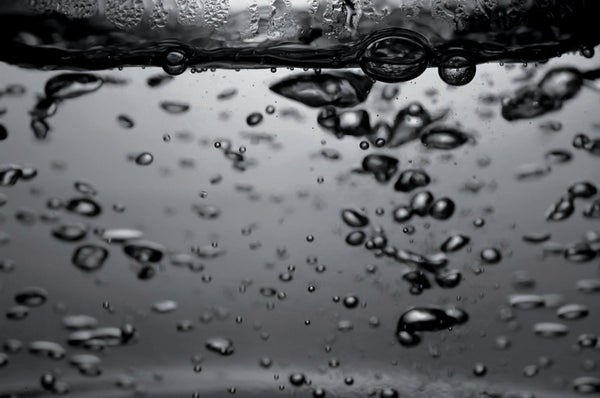
Bubbles rising through boiling water are among nature's best tools for carrying excess heat away from a surface. And now there's a better way to boil: make tinier, speedier bubbles that work in pairs.
It won't help you make a cup of tea faster. But a new microstructured surface, created by Virginia Tech engineer Jonathan Boreyko and his colleagues to produce these specialized bubbles, could help improve heat-transfer efficiency in liquid-cooling systems for data centers and power plants.
When liquid is heated in a metal container, buoyant bubbles form irregularly on the container's smooth bottom surface and detach when they're several millimeters in diameter, then rise and release heat as steam. Boreyko discovered that an array of 80-micron-diameter cavities and 40-micron-wide grooves on a boiling chamber's bottom gave bubbles specific sites on which to form and grow, resulting in smaller, more closely packed bubbles that each quickly coalesced with a nearby neighbor. Changes in surface energy caused these tiny pairs to snap free, jump-starting their ascent and providing more numerous and frequent vehicles for transferring heat.
On supporting science journalism
If you're enjoying this article, consider supporting our award-winning journalism by subscribing. By purchasing a subscription you are helping to ensure the future of impactful stories about the discoveries and ideas shaping our world today.
The design, described in Advanced Functional Materials, also tackled a problem in high-temperature boiling: relatively large bubbles often form a vapor film on a heated surface, insulating it and leading to surface “dry out.” “This innovative jumping-bubble mechanism holds promise in effectively preventing dry out and promoting heat transfer,” says Xianming Dai, a mechanical engineer at the University of Texas at Dallas who studies surface design for energy systems.
According to Boreyko, “the nice thing about jumping bubbles is that they can be achieved with relatively large microstructures” that are more durable than finer-scale nanostructures. And the pattern might be easily stamped or 3-D printed on various materials, says Kansas State University microfluidics engineer Amy Betz. “It could have far-reaching implications in heat exchangers, boilers and electronics cooling,” she adds.
Still, the technology is not yet industry-ready, cautions Guanyu Su, who works on high-temperature thermal storage at the University of California, Berkeley. He agrees that increased bubble departure could help transfer more heat during boiling. “But how much? That remains to be measured,” Su says.