
For a competitive cyclist, there is nothing more physically crushing and psychologically demoralizing than getting dropped by your competitors on a climb. With searing lungs and burning legs, your body hunches over the handlebars as you struggle to stay with the leader. You know all too well that once you come off the back of the pack the drive to push harder is gone—and with it any hope for victory.
I know the feeling because it happened to me in 1985 on the long climb out of Albuquerque during the 3,000-mile, nonstop transcontinental Race Across America. On the outskirts of town I had caught up with the second-place rider (and eventual winner), Jonathan Boyer, a svelte road racer who was the first American to compete in the Tour de France. About halfway up the leg-breaking climb, that familiar wave of crushing fatigue swept through my legs as I gulped for oxygen in my struggle to hang on.
To no avail. By the top of the climb Boyer was a tiny dot on the shimmering blacktop, and I didn’t see him again until the finish line in Atlantic City. Later that night Jim Lampley, the commentator for ABC’s Wide World of Sports, asked what else I might have done to go faster.
On supporting science journalism
If you're enjoying this article, consider supporting our award-winning journalism by subscribing. By purchasing a subscription you are helping to ensure the future of impactful stories about the discoveries and ideas shaping our world today.
“I should have picked better parents,” I deadpanned. We all have certain genetic limitations, I went on, that normal training cannot overcome. What else could I have done?
Plenty, and I knew it. Cyclists on the 1984 U.S. Olympic cycling team had told me how they had injected themselves with extra blood before races, either their own—drawn earlier in the season—or that of someone else with the same blood type. “Blood doping,” as the practice is called, was not banned at the time, and on a sliding moral scale it seemed only marginally distinguishable from training at high altitude. Either way, you increase the number of oxygen-carrying red blood cells in your body. Still, I was already 30 years old and had an academic career to fall back on. I was racing bikes mostly to see how far I could push my body before it gave out. Enhancing my performance artificially didn’t mesh well with my reasons for racing.
But suppose I had been 20 and earning my living through cycling, my one true passion, with no prospects for some other career. Imagine that my team had made performance-enhancing drugs part of its “medical program” and that I knew I could be cut if I was not competitive. Finally, assume I believed that most of my competitors were doping and that the ones who were tested almost never got caught.
That scenario, in substance, is what many competitive cyclists say they have been facing since the early 1990s. And although the details differ for other sports such as baseball, the overall doping circumstances are not dissimilar. Many players are convinced that “everyone else” takes drugs and so have come to believe that they cannot remain competitive if they do not participate. On the governance side, the failure of Major League Baseball to make the rules clear, much less to enforce them with extensive drug testing throughout the season, coupled with its historical tendency to look the other way, has created an environment conducive to doping.
Naturally, most of us do not want to believe that any of these stellar athletes are guilty of doping. But the convergence of evidence leads me to conclude that in cycling, as well as in baseball, football, and track and field, most of the top competitors of the past two decades have been using performance-enhancing drugs. The time has come to ask not if but why. The reasons are threefold: first, better drugs, drug cocktails and drug-training regimens; second, an arms race consistently won by drug takers over drug testers; and third, a shift in many professional sports that has tipped the balance of incentives in favor of cheating and away from playing by the rules.
Gaming Sports Game theory is the study of how players in a game choose strategies that will maximize their return in anticipation of the strategies chosen by the other players. The “games” for which the theory was invented are not just gambling games such as poker or sporting contests in which tactical decisions play a major role; they also include deadly serious affairs in which people make economic choices, military decisions and even national diplomatic strategies. What all those “games” have in common is that each player’s “moves” are analyzed according to the range of options open to the other players.
The game of prisoner’s dilemma is the classic example: You and your partner are arrested for a crime, and you are held incommunicado in separate prison cells. Of course, neither of you wants to confess or rat on the other, but the D.A. gives each of you the following options:
1. If you confess but the other prisoner does not, you go free and he gets three years in jail.
2. If the other prisoner confesses and you do not, you get three years and he goes free.
3. If you both confess, you each get two years.
4. If you both remain silent, you each get a year.
The table below, called the game matrix, summarizes the four outcomes:
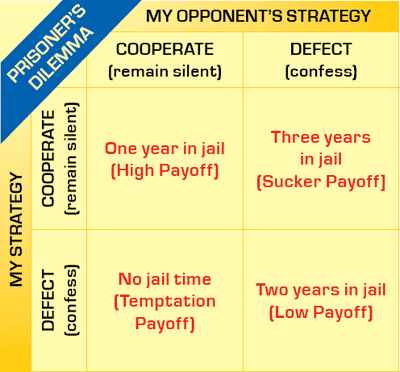
With those outcomes, the logical choice is to defect from the advance agreement and betray your partner. Why? Consider the choices from the first prisoner’s point of view. The only thing the first prisoner cannot control about the outcome is the second prisoner’s choice. Suppose the second prisoner remains silent. Then the first prisoner earns the “temptation” payoff (zero years in jail) by confessing but gets a year in jail (the “high” payoff) by remaining silent. The better outcome in this case for the first prisoner is to confess. But suppose, instead, that the second prisoner confesses. Then, once again, the first prisoner is better off confessing (the “low” payoff, or two years in jail) than remaining silent (the “sucker” payoff, or three years in jail). Because the circumstances from the second prisoner’s point of view are entirely symmetrical to the ones described for the first, each prisoner is better off confessing no matter what the other prisoner decides to do.
Those preferences are not only theoretical. When test subjects play the game just once or for a fixed number of rounds without being allowed to communicate, defection by confessing is the common strategy. But when testers play the game for an unknown number of rounds, the most common strategy is tit-for-tat: each begins cooperating by remaining silent, then mimics whatever the other player does. Even more mutual cooperation can emerge in many-person prisoner’s dilemma, provided the players are allowed to play long enough to establish mutual trust. But the research shows that once defection by confessing builds momentum, it cascades throughout the game.
In cycling, as in baseball and other sports, the contestants compete according to a set of rules. The rules of cycling clearly prohibit the use of performance-enhancing drugs. But because the drugs are so effective and many of them are so difficult (if not impossible) to detect, and because the payoffs for success are so great, the incentive to use banned substances is powerful. Once a few elite riders “defect” from the rules (cheat) by doping to gain an advantage, their rule-abiding competitors must defect as well, leading to a cascade of defection through the ranks. Because of the penalties for breaking the rules, however, a code of silence prevents any open communication about how to reverse the trend and return to abiding by the rules.
It was not ever thus. Many riders took stimulants and painkillers from the 1940s through the 1980s. But doping regulations were virtually nonexistent until Tom Simpson, a British rider, died while using amphetamines on the climb up Mont Ventoux in the 1967 Tour de France. Even after Simpson’s death, doping controls in the 1970s and 1980s were spotty at best. With no clear sense of what counted as following the rules, few perceived doping as cheating. In the 1990s, though, something happened to alter the game matrix.
The EPO Elixir
That “something” was genetically engineered recombinant erythropoietin: r-EPO. Ordinary EPO is a hormone that occurs naturally in the body. The kidneys release it into the bloodstream, which carries it to receptors in the bone marrow. When EPO molecules bind to those receptors, the marrow pumps out more red blood cells. Chronic kidney disease and chemotherapy can cause anemia, and so the development of the EPO substitute r-EPO in the late 1980s proved to be a boon to chronically anemic patients—and to chronically competitive athletes.
Taking r-EPO is just as effective as getting a blood transfusion, but instead of hassling with bags of blood and long needles that must be poked into a vein, the athlete can store tiny ampoules of r-EPO on ice in a thermos bottle or hotel minifridge, then simply inject the hormone under the skin. The effect of r-EPO that matters most to the competitor is directly measurable: the hematocrit (HCT) level, or the percentage by volume of red blood cells in the blood. More red blood cells translate to more oxygen carried to the muscles. For men, the normal HCT percentage range is in the mid-40s. Trained endurance athletes can naturally sustain their HCT in the high 40s or low 50s. EPO can push those levels into the high 50s and even the 60s. The winner of the 1996 Tour de France, Bjarne Riis, was nicknamed Mr. 60 Percent; last year he confessed that he owed his extraordinary HCT level to r-EPO.
The drug appears to have made its way into professional cycling in the early 1990s. Greg LeMond thinks it was 1991. Having won the Tour de France in 1986, 1989 and 1990, LeMond set his sights on breaking what would then have been a record of five Tour de France victories, and in the spring of 1991 he was poised to take his fourth. “I was the fittest I had ever been, my split times in spring training rides were the fastest of my career, and I had assembled a great team around me,” LeMond told me. “But something was different in the 1991 Tour. There were riders from previous years who couldn’t stay on my wheel who were now dropping me on even modest climbs.”
LeMond finished seventh in that Tour, vowing to himself that he could win clean the next year. It was not to be. In 1992, he continued, “our [team’s] performance was abysmal, and I couldn’t even finish the race.” Nondoping cyclists were burning out trying to keep up with their doping competitors. LeMond recounted a story told to him by one of his teammates at the time, Philippe Casado. Casado learned from a rider named Laurent Jalabert, who was racing for the Spanish cycling team ONCE, that Jalabert’s personal doping program was entirely organized by the ONCE team. That program, LeMond said, included r-EPO, which LeMond refused to take, thereby consigning himself to another DNF (“did not finish”) in 1994, his final race.
Some who did go along with the pressure to dope paid an even higher price. Casado, for instance, left LeMond’s team to join one that had a doping program—and died suddenly in 1995 at age 30. Whether his death resulted directly from doping is not known, but when HCT reaches around 60 percent and higher, the blood becomes so thick that clots readily form. The danger is particularly high when the heart rate slows during sleep—and the resting heart rates of endurance athletes are renowned for measuring in the low 30s (in beats per minute). Two champion Dutch riders died of heart attacks after experimenting with r-EPO. Some riders reportedly began sleeping with a heart-rate monitor hooked to an alarm that would sound when their pulse dropped too low.
Trapped in an Arms Race
Just as in evolution there is an arms race between predators and prey, in sports there is an arms race between drug takers and drug testers. In my opinion, the testers are five years away from catching the takers—and always will be. Those who stand to benefit most from cheating will always be more creative than those enforcing the rules, unless the latter have equivalent incentives. In 1997, because there was no test for r-EPO (that would not come until 2001), the Union Cycliste International (UCI), the sport’s governing body, set an HCT limit for men of 50 percent. Shortly afterward, riders figured out that they could go higher than 50, then thin their blood at test time with a technique already allowed and routinely practiced: injections of saline water for rehydration. Presto change-o.
Willy Voet, the soigneur, or all-around caretaker, for the Festina cycling team in the 1990s, explained how he beat the testers in his tell-all book, Breaking the Chain:
Just in case the UCI doctors arrived in the morning to check the riders’ hematocrit levels, I got everything ready to get them through the tests.... I went up to the cyclists’ rooms with sodium drips.... The whole transfusion would take twenty minutes, the saline diluting the blood and so reducing the hematocrit level by three units—just enough.
This contraption took no more than two minutes to set up, which meant we could put it into action while the UCI doctors waited for the riders to come down from their rooms.
How did the new rules of the doping game change the players’ strategies? I put the question directly to Joe Papp, a 32-year-old professional cyclist currently banned after testing positive for synthetic testosterone. Recalling the day he was handed the “secret black bag,” Papp explained how a moral choice becomes an economic decision: “When you join a team with an organized doping program in place, you are simply given the drugs and a choice: take them to keep up or don’t take them and there is a good chance you will not have a career in cycling.”
When Papp came clean, professional cycling slapped him with a two-year ban. But the social consequences were far worse than that. “The sport spit me out,” he lamented to me. “A team becomes a band of brothers,... but with a team of dopers there’s an additional bond—a shared secret—and with that there is a code of silence. If you get busted, you keep your mouth shut. The moment I confessed I was renounced by my friends because in their mind I put them at risk. One guy called and threatened to kill me if I revealed that he doped.”
Papp was never a Tour-caliber cyclist, however, so perhaps the game matrix—with its implications for the rider’s own cycling career—is different at the elite level. Not so, as I learned from another insider. “For years I had no trouble doing my job to help the team leader,” said Frankie Andreu, who was the superdomestique, or lead pacer, supporting Lance Armstrong throughout much of the 1990s. “Then, around 1996, the speeds of the races shifted dramatically upward. Something happened, and it wasn’t just training.” Andreu resisted the temptation as long as he could, but by 1999 he could no longer do his job: “It became apparent to me that enough of the peloton [the main group of riders in a cycling race] was on the juice that I had to do something.” He began injecting himself with r-EPO two to three times a week. “It’s not like Red Bull, which gives you instant energy,” he explained. “But it does allow you to dig a little deeper, to hang on to the group a little longer, to go maybe 31.5 miles per hour instead of 30 mph.”
The Doping Difference
One of the subtle benefits of r-EPO in a brutal three-week race like the Tour de France is not just boosting HCT levels but keeping them high. Jonathan Vaughters, a former teammate of Armstrong’s, crunched the numbers for me this way: “The big advantage of blood doping is the ability to keep a 44 percent HCT over three weeks.” A “clean” racer who started with a 44 percent HCT, Vaughters noted, would expect to end up at 40 percent after three weeks of racing because of natural blood dilution and the breakdown of red blood cells. “Just stabilizing [your HCT level] at 44 percent is a 10 percent advantage.”
Scientific studies on the effects of performance-enhancing drugs are few in number and are usually conducted on nonathletes or recreational ones, but they are consistent with Vaughters’s assessment. (For obvious reasons, elite athletes who dope are disinclined to disclose their data.) The consensus among the sports physiologists I interviewed is that r-EPO improves performance by at least 5 to 10 percent. When it is mixed in with a brew of other drugs, another 5 to 10 percent boost can be squeezed out of the human engine. In events decided by differences of less than 1 percent, this advantage is colossal.
Italian sports physiologist Michele Ferrari, as knowledgeable on doping as he is controversial (because of his close affiliation with elite athletes who have tested positive for doping or been accused of same), explains it this way: “If the volume of [red blood cells] increases by 10 percent, performance [the rider’s net gain in output of useful kinetic energy] improves by approximately 5 percent. This means a gain of about 1.5 seconds per kilometer for a cyclist pedaling at 50 kilometers per hour in a time trial, or about eight seconds per kilometer for a cyclist climbing at 10 kph on a 10 percent ascent.”
In the Tour de France, those numbers imply that a cyclist who boosts his HCT by 10 percent will cut his own time by 75 seconds in a 50-kilometer (31-mile) time trial, a race typically decided by a few seconds. On any of the numerous 10-kilometer (six-mile) climbs in the Alps and the Pyrenees, on grades as steep as 10 percent, that same blood difference would gain the rider a whopping 80 seconds per climb. If any of the top cyclists are on the juice, their erstwhile competitors cannot afford to give away such margins. That is where the game matrix kicks into defection mode.
Nash Equilibrium
In game theory, if no player has anything to gain by unilaterally changing strategies, the game is said to be in a Nash equilibrium. The concept was identified by mathematician John Forbes Nash, Jr., who was portrayed in the film A Beautiful Mind. To end doping in sports, the doping game must be restructured so that competing clean is in a Nash equilibrium. That is, the governing bodies of each sport must change the payoff values of the expected outcomes identified in the game matrix. First, when other players are playing by the rules, the payoff for doing likewise must be greater than the payoff for cheating. Second, and perhaps more important, even when other players are cheating, the payoff for playing fair must be greater than the payoff for cheating. Players must not feel like suckers for following the rules.
In the game of prisoner’s dilemma, lowering the temptation to confess and raising the payoff for keeping silent if the other prisoner confesses increases cooperation. Giving players the chance to communicate before they play the game is the most effective way to increase their cooperation. In sports, that means breaking the code of silence. Everyone must acknowledge there is a problem to be solved. Then drug testing must be done and the results communicated regularly and transparently to all until the test results are clean. That will show each player that the payoff for playing fair is greater than the payoff for cheating, no matter what the other players do.
Here are my recommendations for how cycling (and other sports) can reach a Nash equilibrium in which no one has any incentive to cheat by doping:
1. Grant immunity to all athletes for past (pre-2008) cheating. Because the entire system is corrupt and most competitors have been doping, it accomplishes nothing to strip the winner of a title after the fact when it is almost certain that the runners-up were also doping. With immunity, retired athletes may help to improve the antidoping system.
2. Increase the number of competitors tested—in competition, out of competition, and especially immediately before or after a race—to thwart countermeasures. Testing should be done by independent drug agencies not affiliated with any sanctioning bodies, riders, sponsors or teams. Teams should also employ independent drug-testing companies to test their own riders, starting with a preseason performance test on each athlete to create a baseline profile. Corporate sponsors should provide additional financial support to make sure the testing is rigorous.
3. Establish a reward, modeled on the X prizes (cash awards offered for a variety of technical achievements), for scientists to develop tests that can detect currently undetectable doping agents. The incentive for drug testers must be equal to or greater than that for drug takers.
4. Increase substantially the penalty for getting caught: one strike and you’re out—forever. To protect the athlete from false positive results or inept drug testers (both exist), the system of arbitration and appeals must be fair and trusted. Once a decision is made, however, it must be substantive and final.
5. Disqualify all team members from an event if any member of the team tests positive for doping. Compel the convicted athlete to return all salary paid and prize monies earned to the team sponsors. The threat of this penalty will bring the substantial social pressures of “band of brothers” psychology to bear on all the team members, giving them a strong incentive to enforce their own antidoping rules.
That may sound utopian. But it can work. Vaughters, who is now director of the U.S. cycling team Slipstream/Chipotle, has already started a program of extensive and regular in-house drug testing. “Remember, most of these guys are athletes, not criminals,” he says. “If they believe the rest are stopping [the doping] and feel it in the speed of the peloton, they will stop, too, with a great sigh of relief.”
Hope springs eternal. But with these changes I believe the psychology of the game can be shifted from defection to cooperation. If so, sports can return to the tradition of rewarding and celebrating excellence in performance, enhanced only by an athlete’s will to win.
More To Explore: Breaking the Chain: Drugs and Cycling: The True Story. Willy Voet. Random House UK, 2002.
Behavioral Game Theory: Experiments in Strategic Interaction. Colin F. Camerer. Princeton University Press, 2003.
From Lance to Landis: Inside the American Doping Controversy at the Tour de France. David Walsh. Ballantine Books, 2007.
Rough Ride: Behind the Wheel with a Pro Cyclist. Paul Kimmage. Random House UK, 2007.
The Tour de France: A Cultural History. Christopher S. Thompson. University of California Press, 2008.
