
Fire has long played a role in myth—from Prometheus in ancient Greece, who stole fire from the heavens and earned the wrath of the gods, to Raven in the Pacific Northwest, whose feathers turned black as he brought fire to the world.
But even though fire has been pivotal in human history, much remains unknown about the steps by which our ancestors learned how to use it. A new study suggests this may have been catalyzed by a prolonged pattern of climate change that occurred as humans were first evolving, and made their habitats more prone to wildfire. Early humans may then have learned to exploit the increasingly common fires around them for cooked meals and other benefits, researchers say.
Humans are the only animals known to create and control fire. This has not only helped people stay warm, see in the dark and practice metalworking; much research suggests it influenced the shape of the human body itself. For example, cooking makes it easier to chew and digest many foods, and analyses of reductions in tooth and jaw size suggest that human ancestors may have learned how to cook as early as nearly two million years ago.
On supporting science journalism
If you're enjoying this article, consider supporting our award-winning journalism by subscribing. By purchasing a subscription you are helping to ensure the future of impactful stories about the discoveries and ideas shaping our world today.
A lot remains unknown about how our ancestors developed pyrotechnic abilities, however. A longtime theory holds that early humans discovered how to use fire accidentally—perhaps while making stone tools they found that striking rocks against each other could generate sparks, and then gradually learned fire had many uses.
The problem with such serendipity-based explanations is that they "raise more questions than they answer," says evolutionary anthropologist Christopher Parker at the University of Utah in Salt Lake City. For example, these theories do not address when or where the discovery might have occurred, why it did not happen earlier or why other animals that use stone tools—chimpanzees, capuchin monkeys, crab-eating macaques and sea otters are known to do so—did not also develop fire use, Parker notes.
Parker and his colleagues suggest in a study published in the April Evolutionary Anthropology that humans developed fire use as a natural response to environmental changes. Previous research found that roughly 3.6 million to 1.4 million years ago—as the genus Homo emerged in Africa—the continent regularly experienced bouts of aridity, causing forests to shrink and dry grasslands to spread. Earlier studies suggested these climate shifts may have driven humanity’s ancestors away from a life climbing trees and toward one of walking upright on the ground, Parker says.
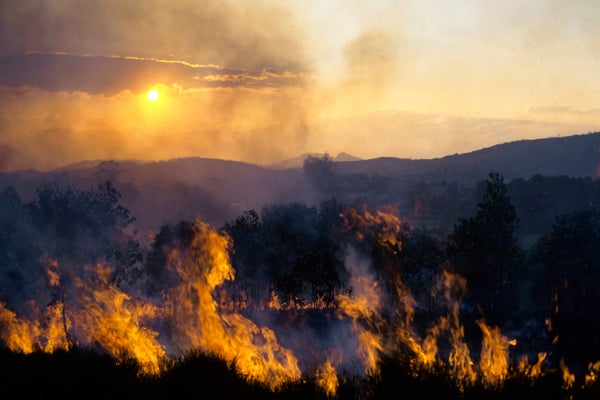
Dry grasslands are ideal tinder, and the aridity that Africa often experienced at the time meant humans likely evolved in environments increasingly prone to fires, Parker says. "The most common cause of natural fire was likely lightning, which can occur without precipitation from clouds," he says. "Another source of natural fire may have been volcanoes, as the region was more tectonically active in the past."
Parker and his colleagues suggest in the new study that our ancestors not only grew accustomed to fire but learned to exploit it as a naturally occurring resource. This adaptation, called pyrophilia, may have set the stage for more active and deliberate human use of fire.
The research team's models suggest early humans benefited from wildfires in a number of ways: The blazes would have made it easier to find food, much as Martu Aboriginal women in Australia still rely on fire to clear brush for more efficient hunting. The models also indicate that early humans might have combed the charred remains of wildfires to dine on animals, seeds, nuts and tubers cooked in the flames—benefitting from a chemical process that not only makes many foods easier to digest but kills germs and neutralizes some toxins.
Overall, the new study suggests that learning how to exploit wildfires may have helped early humans gain more energy from food while spending less time procuring it. The researchers also speculate that over time, early humans may have learned to use still-smoldering wood or grasses from wildfires as tools to set unburned areas on fire to clear land, cook food or both. Pyrophilia may then have laid the groundwork for intentionally creating useful fires. “This research is moving us away from simplistic ideas of the origins of fire use toward evolutionarily meaningful models that may help guide research into how humans came to use fire,” says archaeologist Michael Chazan at the University of Toronto, who did not take part in this study.
Familiarity with naturally caused fires is also seen in chimpanzees, our closest living relatives. Previous research found that chimps in the savannas of Senegal not only can stay calm near wildfires but can also expertly predict how the flames will spread. Parker and his colleagues suggest this tolerance of fire might shed light on how early humans could have adapted to it. The researchers now face the challenge of finding evidence supporting their ideas. They say one possibility might be developing models of African habitats over the past four million years in order to better estimate how frequent natural fires were and whether they might have had the kind of impact on early humans that the researchers suggest. Another possibility involves investigating other primates’ responses to natural fires, and seeing if they match their environments as the scientists predict—for instance, whether savanna primates are better than tree dwellers at taking advantage of burned landscapes.
It may be difficult finding definitive evidence for the notion that early humans exploited wildfires because such behavior may have left few if any archaeological remnants, Chazan says. Still, Parker and his colleagues hope they might be able to find such a smoking gun by examining how modern human foragers such as the Hadza people of Tanzania use fire to acquire food—modern practices that might help scientists identify signs left behind by their ancient predecessors.