

Chimpanzees spend about half their day chewing. "And for context, think about how much time a day you spend chewing." Daniel Lieberman, a professor of human evolutionary biology at Harvard University. "So how did we make that transition, from spending most of our day or half of our day chewing, to spending less than five percent?"
Cooking certainly tenderizes food, making it easier to chew and digest. But evidence for human cookfires goes back only about 500,000 years, if that. And Homo erectus had already evolved weaker jaws, and smaller teeth, more than a million years before that. So Lieberman and his colleague Katherine Zink began their investigation by recreating a paleolithic dinner: yams, carrots, beets… and goat meat. "If you were to try to eat some raw goat with your teeth you would find that you would chew and chew and chew, it's like bubblegum."
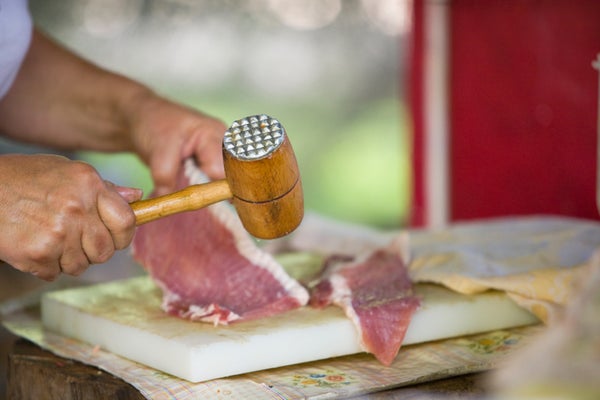
Lucky volunteers got to experience that, by chewing the food. Either in its wild, un-tenderized state, or after it was bashed or sliced with Flintstonian tools. As the study subjects ate, the researchers monitored the frequency and force of each chew. And they found that a diet of abundant, pre-sliced meat, with a side of pounded root vegetables, might have saved Homo erectus two and a half million chews a year. Meaning: less need for big, bulky jaws and teeth. The research is in the journal Nature. [Katherine D. Zink & Daniel E. Lieberman, Impact of meat and Lower Palaeolithic food processing techniques on chewing in humans]
On supporting science journalism
If you're enjoying this article, consider supporting our award-winning journalism by subscribing. By purchasing a subscription you are helping to ensure the future of impactful stories about the discoveries and ideas shaping our world today.
Of course, these days "processed food" has a pretty bad rap. But for our ancestors, food processing was key. "It's hard for people today to imagine what it was like to eat and cook and hunt during those times. For the vast majority of our evolutionary history, our ancestors had to work pretty hard to chew their dinner." Something for you to chew on, perhaps over dinner tonight.
—Christopher Intagliata
[The above text is a transcript of this podcast.]
[Scientific American is part of Springer Nature.]
