
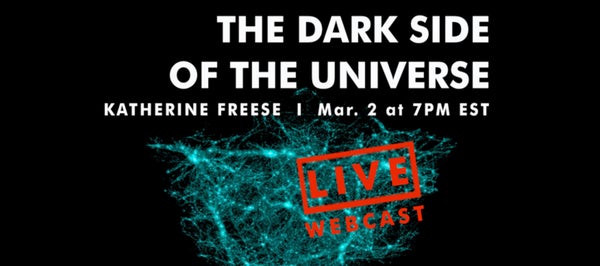
Most everything in the universe is made up of dark matter and dark energy—two invisible, mysterious materials that scientists know very little about. Physicist Katherine Freese of the University of Michigan will present a public lecture tonight at 7 P.M. Eastern time that will be broadcast live on this Web page, which will follow the hunt for these unseen entities via experiments in laboratories, satellites and colliders around the world.
“If we take everything from our daily experience, everything that we know about, it’s made of atoms and all of that adds up to only 5 percent of the universe. The rest is made of dark matter and dark energy,” said Freese in a teaser video for her lecture. “That is what we have to understand. Scientists think [dark matter] is some kind of new fundamental particle, and we’re working very hard to try to discover what it is.”
The lecture, “The Dark Side of the Universe,” is part of a series at the Perimeter Institute for Theoretical Physics in Ontario. Online viewers can pose questions by tweeting to @perimeter and using the #piLIVE hashtag.
On supporting science journalism
If you're enjoying this article, consider supporting our award-winning journalism by subscribing. By purchasing a subscription you are helping to ensure the future of impactful stories about the discoveries and ideas shaping our world today.
You can view videos of some past Perimeter physics lectures below:
Strange, Dense Matter: The Power of Neutron Stars [Video]
How Radioactivity Can Benefit Your Health [Video]
The Promise of Optical Atomic Clocks: Watch Live Wednesday [Video]
The Astonishing Simplicity of Everything [Video] The Man Who Explained the Atom [Video] The Future of Cosmology [Video] The Upgraded LHC and the Search for the Higgs Boson [Video] String Theory LEGOs for Black Holes [Video]