Strange, Dense Matter: The Power of Neutron Stars [Video]

A live Webcast Wednesday evening will discuss the latest science of neutron stars—some of the densest and weirdest objects in space

Perimeter Institute for Theoretical Physics

Join Our Community of Science Lovers!

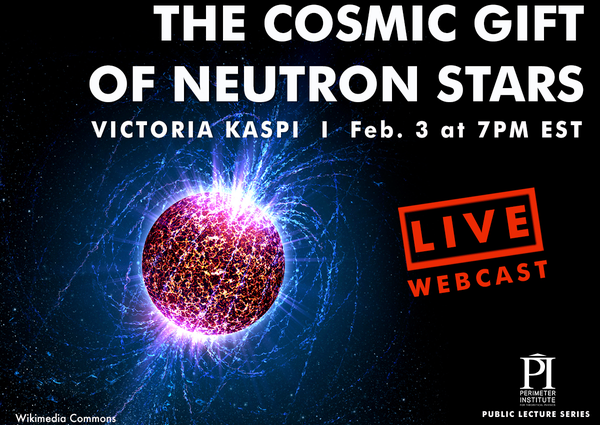
Neutron stars are among the densest things in the universe. They are dead stars where matter has been packed so tightly that the protons and electrons in atoms essentially fuse together to create matter made almost purely of neutrons. To discuss why these objects are so fascinating and useful for astronomy, astrophysicist Victoria Kaspi of McGill University in Montreal will present a public lecture tonight at 7 P.M. Eastern time that will be broadcast live here on this Web page.

“We’re trying to understand neutron stars, how they work and use them as tools to study really a whole variety of different physics and astrophysics, ranging from dynamics in binary systems—including tests of general relativity—all the way to binary evolution and stellar evolution, how stars are born, how stars live, how stars die,” Kaspi said in a teaser video previewing her lecture. “It turns out that neutron stars are really excellent tools for doing very precise measurements in many cases.” The stars shine lighthouse-like beams of light that swirl in circles as the neutron stars rotate. “Their beams cross the Earth and we see a flash of light,” Kaspi said, “and the rotation is really so regular that it’s like ticks of a clock.”

The lecture, “The Cosmic Gift of Neutron Stars,” is part of a lecture series at the Perimeter Institute for Theoretical Physics in Ontario. Online viewers can pose questions by tweeting to @Perimeter and using the #piLIVE hashtag.


On supporting science journalism

If you're enjoying this article, consider supporting our award-winning journalism by subscribing. By purchasing a subscription you are helping to ensure the future of impactful stories about the discoveries and ideas shaping our world today.


You can view videos of some past Perimeter physics lectures below:
Isotopes as the Unlikely Hero of Modern Medicine
The Promise of Optical Atomic Clocks: Watch Live Wednesday
The Astonishing Simplicity of Everything
The Man Who Explained the Atom
The Future of Cosmology
The Upgraded LHC and the Search for the Higgs Boson
String Theory LEGOs for Black Holes

Clara Moskowitz is chief of reporters at Scientific American, where she covers astronomy, space, physics and mathematics. She has been at Scientific American for more than a decade; previously she worked at Space.com. Moskowitz has reported live from rocket launches, space shuttle liftoffs and landings, suborbital spaceflight training, mountaintop observatories, and more. She has a bachelor’s degree in astronomy and physics from Wesleyan University and a graduate degree in science communication from the University of California, Santa Cruz.

More by Clara Moskowitz

It’s Time to Stand Up for Science

If you enjoyed this article, I’d like to ask for your support. Scientific American has served as an advocate for science and industry for 180 years, and right now may be the most critical moment in that two-century history.

I’ve been a Scientific American subscriber since I was 12 years old, and it helped shape the way I look at the world. SciAm always educates and delights me, and inspires a sense of awe for our vast, beautiful universe. I hope it does that for you, too.

If you subscribe to Scientific American, you help ensure that our coverage is centered on meaningful research and discovery; that we have the resources to report on the decisions that threaten labs across the U.S.; and that we support both budding and working scientists at a time when the value of science itself too often goes unrecognized.

In return, you get essential news, captivating podcasts, brilliant infographics, can't-miss newsletters, must-watch videos, challenging games, and the science world's best writing and reporting. You can even gift someone a subscription.

There has never been a more important time for us to stand up and show why science matters. I hope you’ll support us in that mission.

Thank you,

David M. Ewalt, Editor in Chief, Scientific American

Subscribe