
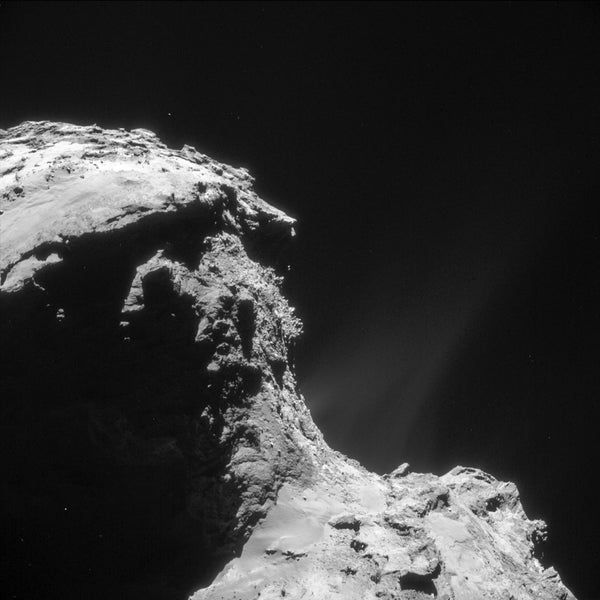
Shortly before 5 A.M. Eastern timeon Friday, the European Space Agency’s Rosetta spacecraft will gently fire its thrusters for a few minutes and begin a 14-hour descent to Comet 67P, a mountain-size, snowy dust ball drifting through the darkness that reigns more than half a billion kilometers from the sun. Starved of solar power, Rosetta’s mission is coming to an end after more than a decade of operations, concluding with a crash into the comet it has shadowed through deep space for two years.
On supporting science journalism
If you're enjoying this article, consider supporting our award-winning journalism by subscribing. By purchasing a subscription you are helping to ensure the future of impactful stories about the discoveries and ideas shaping our world today.
In that time Rosetta revitalized the scientific study of comets—as well as public interest in them—revealing 67P as an ancient and bizarre low-gravity world of impossibly soaring cliffs, crumbling boulder-scapes and hissing jets of water laced with cocktails of organic chemicals. It traced the comet’s history, linking it to a cold birthplace somewhere in the solar system’s outer depths and conclusively dismissing the possibility that water from objects like it had been the source for Earth’s oceans. Zooming in on the comet’s surface, Rosetta spied mysterious meter-size “goose bumps” thought to be the primordial building blocks of 67P. Rosetta even deployed an ill-fated lander, Philae, which captivated the world as it struggled for survival after bouncing into a crevice too dark and deep to escape.
Nature’s senior physical sciences reporter Elizabeth Gibney covered it all, regularly reporting on the spacecraft’s status and the activities of its scientists back on Earth as the mission progressed. Join her now for an exclusive front-row perspective on this historic mission’s conclusion, as she—along with Rosetta team members Stephen Lowry and Geraint Jones—follows the craft’s descent to 67P, live from Nature’s studio. The trio will discuss Rosetta’s legacy and provide insightful updates on Rosetta’s activities throughout its final hours, which could still hold surprises. In the last moments before it loses contact with Earth, the spacecraft will send back high-resolution images of its final resting place, a region called Ma’atthat is strewn with pits, dust jets and goose bumps. What will Rosetta see just before it falls silent forever? Tune in to find out.