
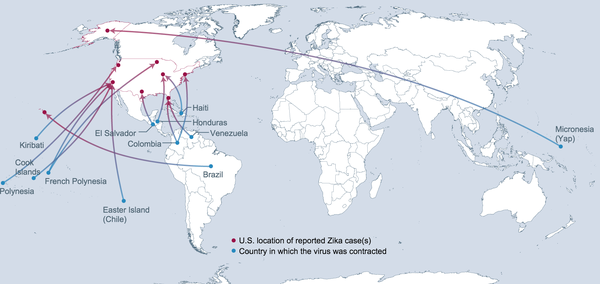
Editor's Note (3/30/16): The maps below are no longer being updated. Their last update on March 22 reflected additional confirmed cases in the U.S. and their countries of origin. For the latest official count on travel-related cases of Zika in the U.S. (their countries of origin are not included) please refer to the CDC’s tracking here.
Zika is not new to the U.S. Even as early as 2007, when the mosquito-borne disease had its first large outbreak in the Pacific island nation of Micronesia, the virus directly touched the U.S.—sickening one American traveler. Since then more than 50 domestic cases have been reported, all from travelers who contracted Zika in more than a dozen countries around the globe. To create these exclusive maps, Scientific American launched its own investigation, gathering and analyzing information from all 50 states’ health departments, to depict a more nuanced picture of how this disease has been carried back to the U.S. via jet-setters. In the current outbreak, there has been only one instance of local Zika virus transmission in the country (a case of apparent sexual contact with an infected individual in Texas). State and federal health officials, however, are bracing themselves for future clusters of disease in the U.S. transmitted by local mosquitoes.
On supporting science journalism
If you're enjoying this article, consider supporting our award-winning journalism by subscribing. By purchasing a subscription you are helping to ensure the future of impactful stories about the discoveries and ideas shaping our world today.
Zika, the mosquito-borne disease linked to a worrisome birth defect called microcephaly and another autoimmune disease, has been brought back to the U.S. in the bloodstreams of some 20-plus travelers since 2007. They picked it up in more than a dozen countries, mostly across South and Central America. Although the two types of mosquitoes capable of transmitting the virus are already in the U.S., so far, the virus has not been spread locally here.
GRAPHIC BY AMANDA MONTAÑEZ
To protect patient privacy the U.S. Centers for Disease Control and Prevention declined to provide the locations of Zika cases in the U.S. but that information is available from state health departments. Until recently state health officials did not require physicians and hospitals to report Zika virus disease, so it is possible that some cases may have not been captured by state records. These maps represent the most comprehensive U.S. data available to date. Scientific American will continue to update them as more U.S. Zika cases are confirmed and their histories evolve.
There have been more than two dozen Zika cases confirmed in the U.S. since 2007. The first one, in Alaska, traces back to a medical volunteer who had worked in Yap, Micronesia, during an outbreak that afflicted 70 percent of that tiny archipelago's population. Cases among U.S. travelers are expected to continue to increase. This map will be updated as more cases are confirmed.
Cases reported in Washington, D.C. are included in Maryland data.
GRAPHIC BY AMANDA MONTAÑEZ
Zika is typically pretty mild—causing a week of flulike aches and rash. But the virus has also been linked to an autoimmune disease that can cause paralysis called Guillain–Barré syndrome as well as an alarming surge in a birth defect called microcephaly in Brazil. The condition, characterized by an abnormally tiny head and potential brain damage, has already prompted health officials in neighboring Colombia and El Salvador to suggest women should wait to get pregnant if at all possible while health officials attempt to tamp down Zika. Already, one pregnant woman who likely contracted the virus in Brazil in May 2015 later gave birth to a baby in Hawaii suffering from microcephaly. On January 25 the World Health Organization said that Zika would spread throughout the Americas because the mosquitoes that transmit it are everywhere except in Chile and Canada. (For more on where they are in the U.S., see here.)