

“Creationism evolves and sometimes those new strategies succeed.”
Nicholas Matzke, an evolutionary biologist currently on a fellowship at the Australian National University in Canberra.
“So I think a lot of people, it might not have been on their radar, that we have two states that have a statewide policy that encourages teachers to introduce sort-of false criticisms of evolution…and it also more explicitly tries to prevent administrators from doing anything about it.”
On supporting science journalism
If you're enjoying this article, consider supporting our award-winning journalism by subscribing. By purchasing a subscription you are helping to ensure the future of impactful stories about the discoveries and ideas shaping our world today.
Those states are Tennessee and Louisiana. Matzke used to work for the National Center for Science Education, the NCSE, which tracks these legislative efforts to get religiously motivated creationism and its thinly disguised offshoots like Intelligent Design into public school classrooms.
Matzke and the NCSE were involved in the Kitzmiller versus Dover case in Pennsylvania in which the judge found the inclusion of Intelligent Design in the biology curriculum to be a violation of the First Amendment. December 20th marks the 10th anniversary of that decision. But dozens of similar bills that do not explicitly mention creationism or intelligent design have been proposed since.
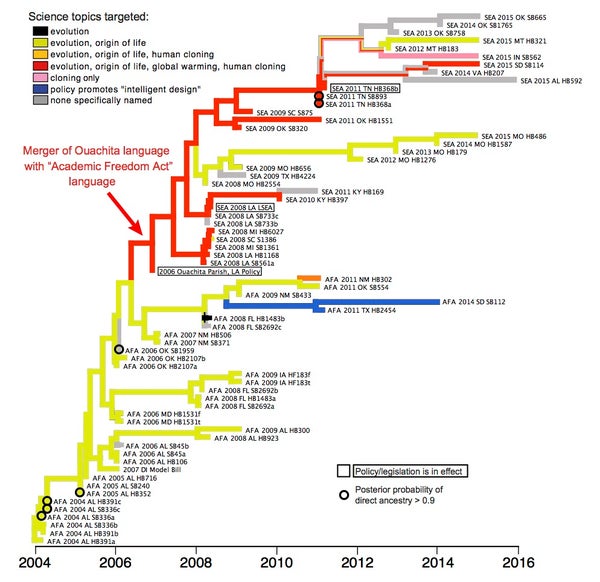
“Over the years I’d kept in touch with NCSE people and we had always talked about, you know, these bills look like they’re just being copied and modified, we should do a phylogeny at some point—do an evolutionary analysis of them…so it had gotten up to being about 60 bills…I took all those bills, lined up all those texts, coded all the characteristics, all the variations between these texts, and then ran them through the standard phylogenetic analyses that we use for DNA. We use them for dinosaurs, they get used to study virus evolution. Those same programs can be used on texts that have been copied and modified.”
Matzke’s tongue in cheek, or rather panda’s thumb in a creationist’s eye, analysis is in the journal Science. [Nicholas J. Matzke, The evolution of antievolution policies after Kitzmiller v. Dover]
It reveals a high degree of relatedness among the bills—that is, legislators make slight alterations in bills either from their own state or other states in the hopes that this time the particular wording will get the bill passed.
“With the phylogenetic analysis we can tell when do these steps happen and how influential are they on future antievolution legislation…so it’s worth alerting people to the fact that these bills exist and alerting people to how these strategies change through time.”
—Steve Mirsky
[The above text is a transcript of this podcast.]
