
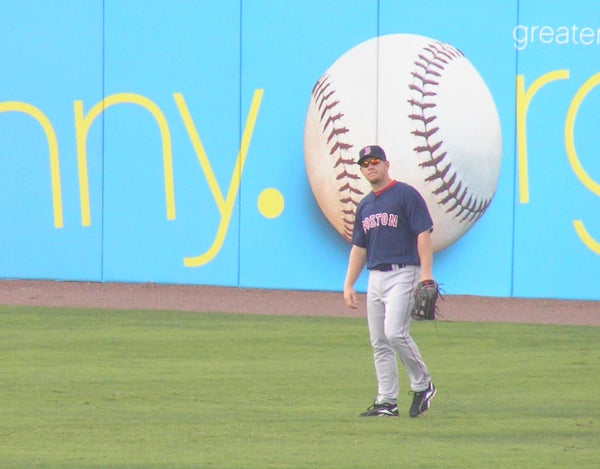

“Take this quote from Mickey Mantle. After hitting this monstrous home run, he said he couldn’t really explain it, he just saw the ball as big a grapefruit.”
Jessica Witt of Colorado State University, February 13th at the annual meeting of the American Association for the Advancement of Science in Washington, D.C. To see if athletes performing better really do perceive their environment differently, she went to softball games.
“And when the games were over I lured the players over to my booth with promises of Gatorade. And I showed them this poster board. And I said which of these circles is the same size as the softball. And this is how we measure perception. It’s hard to measure perception because perception is an internal state…well, one way we can measure it is to do experiments like this, where we say, okay, which one of these matches what you see. And what I found was that people who hit better selected a larger circle, meaning the batters who were hitting better saw the ball as bigger. Which means not everyone sees the ball the same way. And it also means that what we see is affected by our ability to act. Performance impacts vision.”
On supporting science journalism
If you're enjoying this article, consider supporting our award-winning journalism by subscribing. By purchasing a subscription you are helping to ensure the future of impactful stories about the discoveries and ideas shaping our world today.
In other studies she found that golfers who putted better saw the hole as bigger than did poor putters. Faster swimmers saw targets underwater as being closer than did slower swimmers. And she had athletes who were not placekickers try to make field goals. The ones who did better saw the space between the uprights as wider. Bottom line:
“You don’t see the world the same as each other. We’re showing that you see the world in a way that’s unique to you, and it’s unique to your abilities.”
—Steve Mirsky
[The above text is a transcript of this podcast.]
