New Issue: Orbital Catastrophe Ahead? Read Now

Eavesdrop on Echolocation to Count Bats

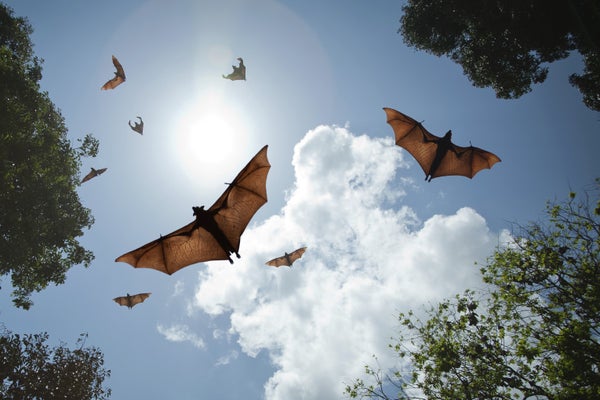
Researchers created a model that can accurately predict a cave's bat populations using audio alone. Christopher Intagliata reports.

Getty Images/iStockphoto/Thinkstock (MARS)

Illustration of a Bohr atom model spinning around the words Science Quickly with various science and medicine related icons around the text

Join Our Community of Science Lovers!

[Sound of bat echolocation]

"What you're listening to is what I like to call the beautiful chaos of the bat echolocation stream." Laura Kloepper, a bioacoustician at Saint Mary's College in Indiana. "So you're listening to the sound of probably a couple hundred bats emerging per second from the cave and there's a microphone that we have suspended in the middle of the bats to record the sounds. These are the echolocation sounds the bats make when they're flying and this is what they use to help navigate and find prey."

The sounds—slowed down 10 times so we can hear them—were recorded at a network of lava tube caves in New Mexico. Kloepper and her colleagues camped out there to study how Mexican free-tailed bats echolocate in huge swarms without jamming each other's signals. And they noticed that the intensity of the “bleeps” seemed to correlate with the number of bats fluttering out of the cave. Meaning, maybe you could survey their populations with audio. "One night we were sitting around the campfire at our field site and we said, I wonder if this would actually work?"


On supporting science journalism

If you're enjoying this article, consider supporting our award-winning journalism by subscribing. By purchasing a subscription you are helping to ensure the future of impactful stories about the discoveries and ideas shaping our world today.


So they set up a new experiment, capturing audio and GoPro video at the cave site. They counted the bats in each video frame, and correlated that to the zips and zaps <>, to create predictive models. They then tried the method at another cave—and found that their models could indeed estimate the number of bats emerging using acoustics alone. The study is in the journal Royal Society Open Science. [Laura N. Kloepper, Estimating colony sizes of emerging bats using acoustic recordings]

"Historically what has been used to estimate bats has been photographic estimates, visual estimates, mark-recapture estimates, and those have been highly prone to bias." Newer technology, like thermal imaging cameras is accurate, but expensive. So at a time of epic bat mortality—due to, for example, the fungal white nose syndrome that’s wiping out bats in Canada and the U.S.—Kloepper says her method might be a cheap, reliable way to determine the most critical caves to save.

—Christopher Intagliata

[The above text is a transcript of this podcast.]

Subscribe to Support Independent Journalism

Great science journalism requires human expertise, time, effort and creativity. And it costs money. That’s why I and the journalists here at Scientific American hope you’ll join our community.

When you subscribe, you are supporting staff and freelance journalists who are passionate about telling science stories that are true, important and compelling. Our editors and reporters are often experts in their fields, which means they understand the nuances of big discoveries and can untangle the breakthroughs from the hype. With a subscription, you are also supporting rigorous fact-checking to ensure the words we publish are precise and accurate. And you’re supporting original illustrations, graphics and photos that bring you closer to an advanced laboratory, an ice sheet in Antarctica or a space mission in orbit. You’re helping us craft other types of high-quality journalism as well: Our newsletters are carefully written, edited and curated by staffers you have or will come to know and love. Our Science Quickly podcast is based on original reporting, collaboration with editors and scientists and exacting production.

Subscriptions keep this engine running so we can continue to deliver thoughtful, rigorous and independent science journalism to you. In an era of viral misinformation, this work is crucial. If you value what we do, I hope you’ll consider joining us as a subscriber

Thank you,

Jeanna Bryner, Editor in Chief, Scientific American

Subscribe