
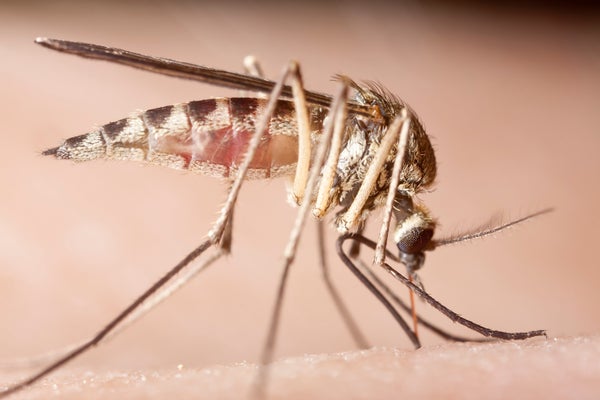

Malaria infection begins when a mosquito injects the Plasmodium parasite into the blood. But getting sick is not a certain outcome. "The vast majority of people really only develop either mild malaria or even asymptomatic infections." Nathan Schmidt, a cellular immunologist at the University of Louisville. "It's a very small subset of the hundreds of millions of cases that progress to severe malaria."
Some of the variation in illness severity is genetic. Or whether the patient is partially immune, thanks to past exposures. But Schmidt and his colleagues have found another factor that could influence the disease: the host's microbiome.
The first clue came during an experiment in lab mice: even though the mice were almost identical genetically, mice that had been bought from different vendors showed variability in their response to infection by the malaria parasite. Turns out, the mice had different microbiomes.
On supporting science journalism
If you're enjoying this article, consider supporting our award-winning journalism by subscribing. By purchasing a subscription you are helping to ensure the future of impactful stories about the discoveries and ideas shaping our world today.
So the researchers did more tests—they transplanted the gut bugs of both the resistant and the susceptible animals into other mice that had no gut bacteria. And again, mice that now had the resistant microbial mix were spared the worst of a malaria infection—possibly through some sort of 'booster effect' on their immune system thanks to the microbes. The study appears in the Proceedings of the National Academy of Sciences. [Nicolas F. Villarino et al, Composition of the gut microbiota modulates the severity of malaria]
As for optimizing our microbiomes? "I think that we're pretty far away from this having any kind of real therapeutic potential for humans." Yogurt alone, for example, did not much help the mice. But if and when we do find the right recipe for the anti-malarial microbiome, the researchers say, it could lessen the parasite's effects. And perhaps save thousands of lives.
—Christopher Intagliata
[The above text is a transcript of this podcast.]
