
February 1967
Gene Therapy
“Some biologists have wondered if it might someday be possible to alter the genetic material of a human being, for example, to supply a deleted gene and thereby remedy some metabolic deficiency. How would one introduce the desired genetic information? One possibility that has now received some preliminary experimental support would be to administer a harmless virus that bears the required gene. The Shope papilloma virus, which causes tumors in rabbits, also induces the synthesis of a distinctive form of the enzyme arginase. The question arose whether the same effect might be obtained in human beings, but one may not infect people with animal viruses for experimental purposes. Stanfield Rogers of the Oak Ridge National Laboratory got at the question indirectly: the blood of people who had worked with, and therefore been exposed to, the Shope virus was found to be carrying ‘virus information.’ The Shope virus, Rogers suggests, is a harmless ‘passenger’ virus in these people. It is possible that there are other such viruses.”
On supporting science journalism
If you're enjoying this article, consider supporting our award-winning journalism by subscribing. By purchasing a subscription you are helping to ensure the future of impactful stories about the discoveries and ideas shaping our world today.
February 1917
Mosquito Killers
“A report to the French Academy of Sciences tells of a unique experiment in combating a mosquito plague. Myriads of mosquitoes infest the rice plantations of Madagascar, and it occurred to Dr. Legendre to fight the marsh fever [malaria] caused by the bite of the mosquito by introducing into the watercourses the ‘Cyprin’ or red fish [goldfish], which is a glutton as a devourer of mosquitoes. Dr. Legendre introduced 500 of these fishes into the streams of one district, and in five months they had multiplied and destroyed all the mosquitoes. The natives have found the red fish very much to their liking, and they are proving an important addition to their stock of food.”
War Clouds Looming
“If we are drawn into the world war, we may well prove to be the decisive factor; even though we land not a single soldier upon European soil. Excellent though it may be in morale and in its all-round military efficiency, our army would be lost amid the embattled millions of Europe; and our battleships would be superfluous in the North Sea. But the moment our enormous financial resources and our vast potentiality for the manufacture of guns, powder and shells were lined up behind the allied armies, the ultimate overthrow of the Central Powers would be as certain as the rise and setting of the sun.”
February 1867
National Academy of Design
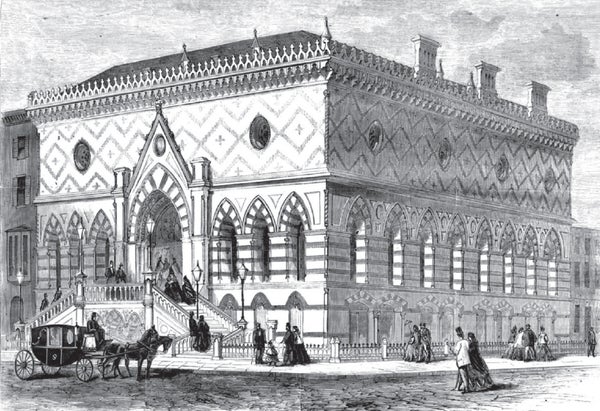
“Forty-two years ago the resident artists of the city of New York united in forming a ‘Drawing Association,’ having for their object the study of art and social intercourse among the members. In 1826 they adopted the name of the National Academy of Design. An important era in the history of the organization witnessed the completion of the magnificent edifice located on 23rd Street, corner of Fourth Avenue [now called Park Avenue South], and represented in the accompanying engraving [see illustration]. The style of architecture may be designated the ‘revived Gothic,’ embracing the features of the different schools of architecture of the Middle Ages, which are most appropriate for our buildings of modern date. The building was designed by Mr. Peter Bonnett Wight of this city.”
The academy sold the building in 1899, and it was torn down.
Words, Words, Words
“Prof. Max Müller quotes the statement of a clergyman that some of the laborers in his parish had not 300 words in their vocabulary. A well-educated person seldom uses more than about 3,000 or 4,000 words in actual conversation. Shakespeare, who displayed a greater variety of expression than probably any other writer in any language, produced all his plays with about 15,000 words.”
