
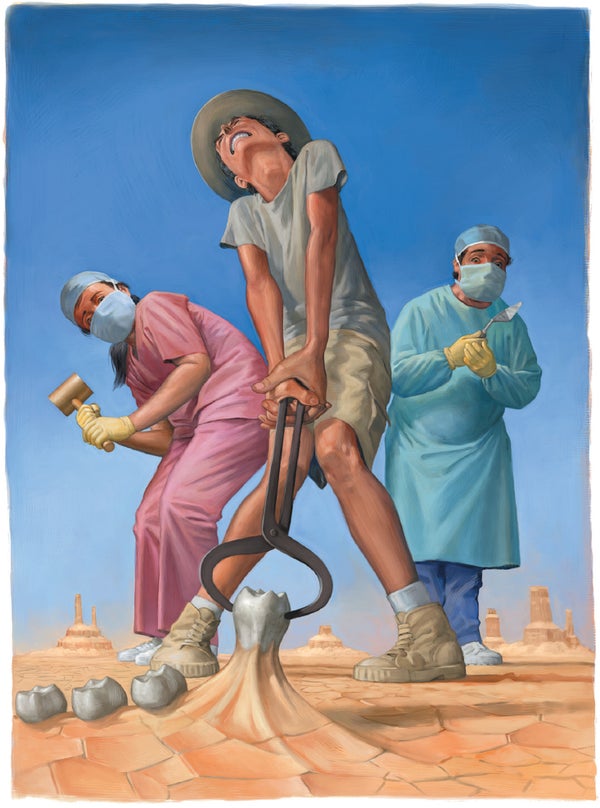
Brush your fossils twice a day. Do it for yourself and for future researchers and museum visitors. Because if any part of you is going to get unearthed millions of years from now, it'll probably be a tooth. “Teeth are stronger than bones, and they are much more likely to survive the ages,” writes University of Arkansas paleoanthropologist Peter S. Ungar in his book Evolution's Bite: A Story of Teeth, Diet and Human Origins. Not to be confused with Felix Unger, who once invested in a dental adhesive based on the substance barnacles produce to stick to ships. (Watch The Odd Couple, season 4, episode 13: “A Barnacle Adventure.” Spoiler alert: the glue fails when the patient's mouth gets dry.)
In fossil bones, most of the material that existed while the animal was alive gets slowly replaced over time by minerals. The resulting buried treasure is really a natural cast of the bone with properties more like rock than like what's inside The Rock (aka Dwayne Johnson). Teeth start out most of the way there. “Teeth are essentially ready-made fossils,” Ungar writes. “The enamel that coats ours, for example, is 97% mineral.” Such prefossilization means “there are often hundreds if not thousands of teeth for every skeleton or complete skull we find.... Fortunately for paleontologists, they are also excellent tools for understanding life in the past.”
Teeth tell such tales because their shapes and the usage patterns etched on them offer up heaping helpings of information about what animals ate and how they lived. “If we can reconstruct diet from teeth, for example,” Ungar writes, “we can use them as a bridge to the worlds of our ancestors.” Likewise, your teeth could one day serve as a bridge. Unless, of course, you have a bridge.
On supporting science journalism
If you're enjoying this article, consider supporting our award-winning journalism by subscribing. By purchasing a subscription you are helping to ensure the future of impactful stories about the discoveries and ideas shaping our world today.
While reading Ungar, I could not help but think about Don McLeroy, a man who vexed scientists and educators for the first decade of this century in his roles as a member and then chair of the Texas State Board of Education. McLeroy fought against the inclusion of evolution in curricula. He believed that the earth is only a few thousands of years old. He was quoted as saying, “Evolution is hooey.” And that “somebody's got to stand up to experts.” All those views would be irritating if McLeroy's day job had been as a plumber or an architect or an insurance agent. But what made McLeroy particularly maddening was that he worked on a daily basis with the most abundantly clear evidence of evolution that can be found in the fossil record: he is a dentist.
While you're chewing on that irony, consider that for hundreds of millions of years some animals have avoided the teeth of predators by getting down and dirty. “Imagine yourself the size of a shrew and living in environments where dinosaurs are everywhere,” writes Emory University paleontologist Anthony J. Martin in his book The Evolution Underground: Burrows, Bunkers, and the Marvelous Subterranean World beneath Our Feet. Yes, that's a mouthful.
“Some want to eat you, while others will carelessly step on you and carry your squashed remains like chewing gum on their feet for days,” Martin continues. “Oh, you say you live in deep burrows where no dinosaurs can find you or compress you into two dimensions? Yes, that will do nicely.... Congratulations, shrew-sized mammal: You win the survival sweepstakes, and one tiny branch of your descendants eventually gets to a point where it can discuss how you outlived the dinosaurs.” Plus, when the asteroid bit into a big chunk of what's now the Yucatán Peninsula 66 million years ago, stuff that lived underground—and far away—clearly had a significant survival advantage.
In fact, Martin argues that “the evolutionary paths taken by most modern animals, whether these are crocodilians, turtles, birds, lungfish, amphibians, earthworms, insects, crustaceans, or mammals, are connected to their burrowing ancestors.” That passage can be found deep in the book under the subhead “Living on Burrowed Time.” Holy moly.
I dug both books. Sink your teeth into them.