
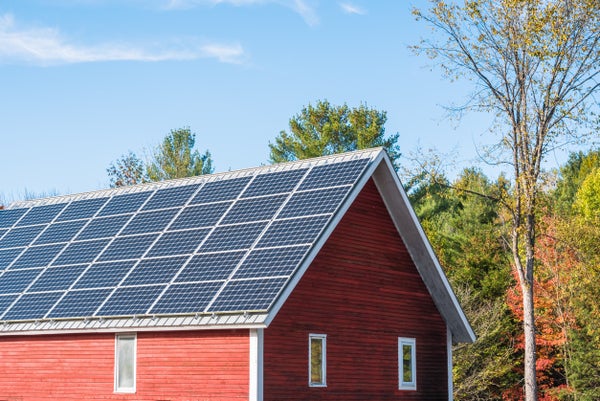
The expansion of solar-powered electricity in the U.S. broke major records last year, accounting for nearly 40% of all new generating capacity. And total installed photovoltaic (PV) power is expected to more than double in the next five years, according to an annual report released today by the Solar Energy Industries Association and Wood Mackenzie, a global energy research and consulting firm.
The U.S. growth, a 23% jump over 2018, was led by California, where concern over forest fires and solar requirements for newly built homes pushed up PV demand. It was followed by dramatic solar growth in the Northeast and in sunny Texas and Florida.
Conversions to solar in the utility sector were the “bedrock” of national growth. The shift was partly motivated by companies that wanted to qualify for a federal investment tax credit for solar power systems before the credit begins to taper off and then expire in 2022 for customer-owned systems.
On supporting science journalism
If you're enjoying this article, consider supporting our award-winning journalism by subscribing. By purchasing a subscription you are helping to ensure the future of impactful stories about the discoveries and ideas shaping our world today.
Solar’s growth continues in the utility sector despite increasingly expensive tariffs on imported PV panels. Over the next five years the growth is expected to “nearly double the amount installed over the last ten years.”
According to the report, it helps that 28 states have set CO2 emission reduction targets and that 23 states have signed the U.S. Climate Alliance pledge to reduce economy-wide emissions by 28% by 2025.
It predicted that solar markets in Pennsylvania and Colorado would be the next to take off and that policy changes in New York, Maryland and Maine soon would boost solar growth there.
Increasingly, the combination of the use of solar power and the adoption of new ways to store it will begin to support nonresidential demand as policymakers and business leaders recognize the value of energy storage to close some of the gaps in the availability of wind and solar due to weather variability.
In a separate report released last week, DNV GL, the Norway-based global energy risk management and research and development firm, predicted that in future years long-term energy storage systems coupled with solar use would continue to boost the growth of solar by businesses and governments.
Using a case study on the seasonal variability of solar energy in the Netherlands, DNV GL predicted that—depending on the level of their carbon taxes—some nations would be able to rely on natural gas they have paid taxes for and stored to provide more energy during seasons with less solar power.
As the use of renewable energy, such as wind and solar power, continues to expand with the addition of electric cars and trucks, nations could plug the gaps in such variable energy sources by taking advantage of new technologies—beginning with the accumulation of hydrogen made from solar and wind power.
The resulting “green” hydrogen can be compressed and stored, and sold as a fuel for electric vehicles that have fuel cells. Or it can be converted into methane, the main component of natural gas, which also can be stored.
“For grid operators, this can be of value for keeping the voltage and current of the grid within required boundaries,” the DNV GL report said. It added that, as renewable energy supplies continue to grow, energy companies may find engagement in energy storage business as a source of “potentially very large, but also infrequent revenue streams.”
Reprinted from Climatewire with permission from E&E News. E&E provides daily coverage of essential energy and environmental news at www.eenews.net.
