
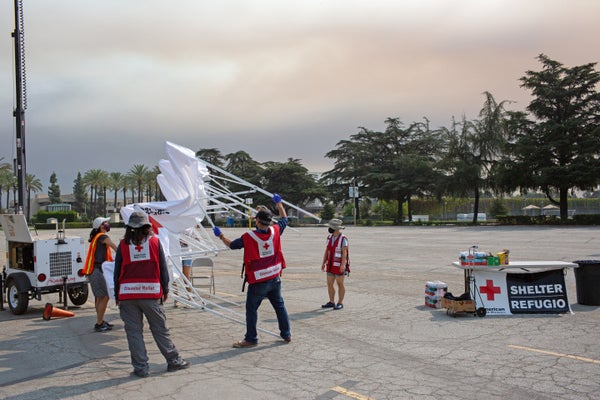
The American Red Cross has provided record levels of disaster shelter this year as unprecedented hurricane and wildfire seasons forced massive evacuations and the COVID-19 pandemic made evacuees financially needy and reluctant to stay with relatives and friends.
The Red Cross has furnished more than 1.2 million nights of sheltering so far this year to people fleeing disasters. That’s more than four times the disaster-related shelter assistance the organization provides in an average year.
Only 10% of the evacuees stayed in traditional shelter settings such as schools and civic centers. The rest stayed in hotel rooms the Red Cross rented to avoid having evacuees potentially exposed to the coronavirus.
On supporting science journalism
If you're enjoying this article, consider supporting our award-winning journalism by subscribing. By purchasing a subscription you are helping to ensure the future of impactful stories about the discoveries and ideas shaping our world today.
“We had just a rampant pace of disasters across the country,” said Trevor Riggen, the Red Cross senior vice president of disaster cycle services. “The number of times people had to evacuate and seek shelter was greater than we’ve seen before.”
Although 2020 was a record for disaster sheltering, Riggen said there is a long-term, climate-driven trend toward increasingly damaging hurricanes and wildfires that is creating “a chronic disaster season for us.”
The Red Cross, the nation’s leading nongovernmental provider of disaster shelter, has agreements with many states and the Federal Emergency Management Agency to provide evacuees with housing, meals and services. Other organizations and government agencies also provide disaster shelter.
The 2020 Atlantic hurricane season, which ended yesterday, saw a record 30 named storms this year including 13 hurricanes—six of which were “major hurricanes” reaching Category 3 or higher.
A record 12 of the named storms hit the U.S. coastline, breaking the previous high of nine storms that made landfall in 1916. Named storms include hurricanes and tropical storms, which have sustained winds of at least 39 mph.
NOAA has calculated that there were 16 “billion-dollar disasters” through September, tying the one-year record set in 2017 and 2011. The 16 disasters this year—which include storms, tornadoes, heat waves, droughts, extreme winds and wildfires—killed 189 people and caused $47 billion in damages, according to NOAA.
“Families are overwhelmed coping with the greatest number of billion-dollar disasters in a single year—on top of the coronavirus pandemic,” Red Cross CEO Gail McGovern said in a statement.
The year also saw wildfires burn a record number of acres in California and Oregon and force tens of thousands of evacuations in those states and in other areas such as Colorado.
The COVID-19 pandemic amplified the impact of disasters because many people had lost their jobs and could not afford to pay for their own hotel rooms or to travel long distances to stay with friends or family.
“We’ve seen more people seek out help because of that,” Riggen said. “It’s expensive for a family to find a place to stay, to find a hotel on their own, to eat out every day.”
Evacuees whose homes were destroyed have faced difficulty finding new homes, in part because the pandemic has led to less turnover in housing and fewer vacancies, Riggen said.
In Louisiana—which was hit by five named storms this year, most recently Hurricane Zeta in late October—more than 1,700 people remain in emergency hotel lodging through the Red Cross.
Most of the organization’s disaster sheltering nationwide was for people evacuating from hurricanes and tropical storms in the Gulf Coast.
The Red Cross minimized the use of congregate shelters and housed almost all of the evacuees it handled in hotel rooms, which were plentiful because the pandemic has sharply scaled back business travel and tourism.
“We were able to move families much more quickly into hotels than we expected,” Riggen said. “One of the few benefits of the environment we’re in now is the rooms were available. The hotel industry was very good to work with.”
FEMA had warned in May that states and counties should minimize both evacuations and the use of congregate shelters to contain the coronavirus.
The Red Cross also was able to maintain much of its volunteer force despite fears that people would decline to offer help to avoid exposure. “For the most part, our volunteers showed up,” Riggen said, citing “massive recruitment plans.”
Reprinted from Climatewire with permission from E&E News. E&E provides daily coverage of essential energy and environmental news at www.eenews.net.