
Editor’s Note (12/9/24): This story is being republished after the Copernicus Climate Change Service released global temperature data from November. The data confirmed that it is “effectively certain” that 2024 will be the warmest year on record and will surpass 1.5 degrees Celsius above preindustrial temperatures.
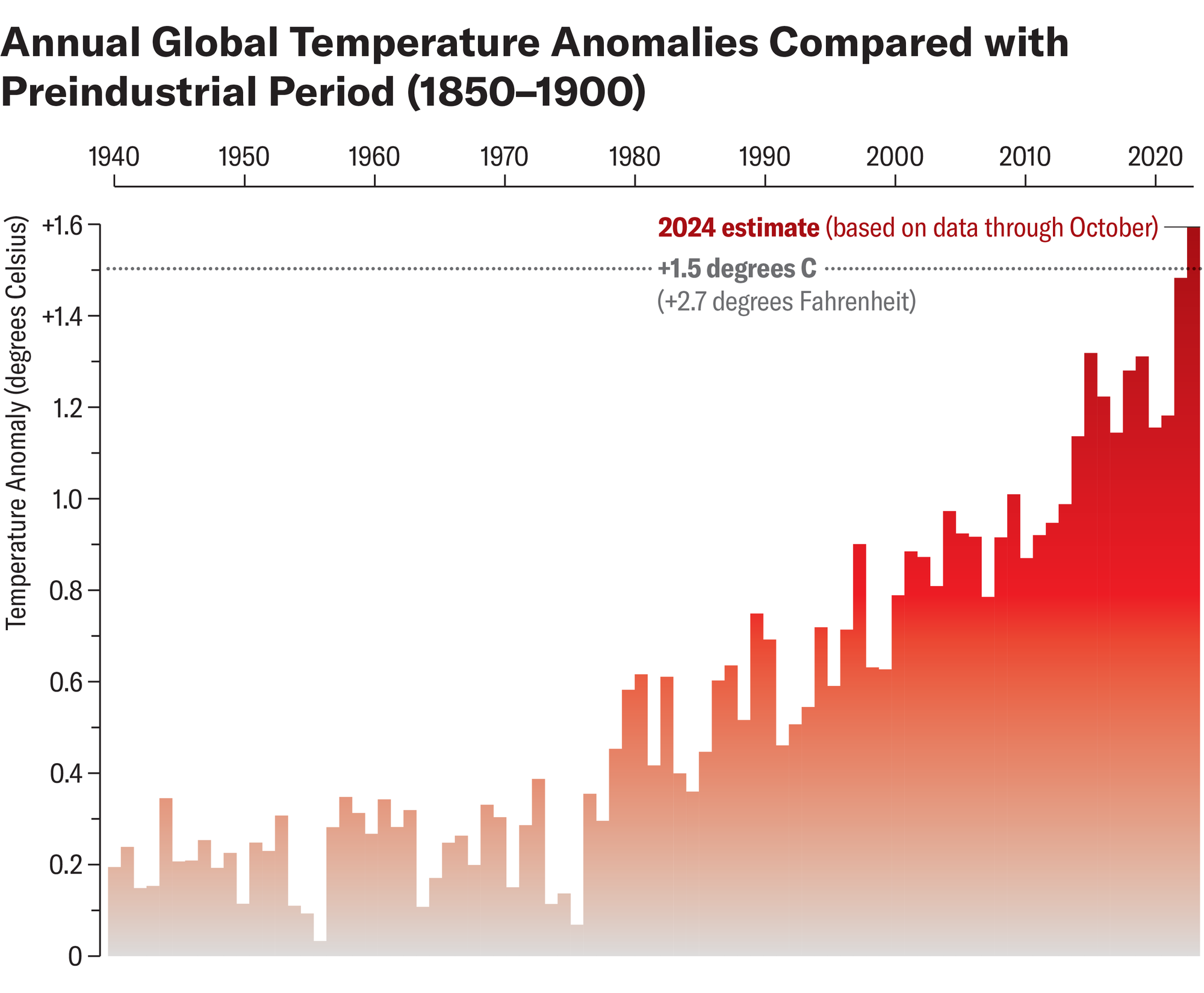
It is “virtually certain” that 2024 will be the first year to be more than 1.5 degrees Celsius (2.7 degrees Fahrenheit) hotter than in the preindustrial era, before heat-trapping fossil fuels began accumulating in the atmosphere, the European Union’s Copernicus Climate Change Service (C3S) announced today.
These dubious distinctions mean 2024 will surpass the remarkable record annual temperatures set just last year, one of the clearest markers of the unfolding planetary climate catastrophe. “This marks a new milestone in global temperature records and should serve as a catalyst to raise ambition for the upcoming Climate Change Conference, COP29,” Samantha Burgess, deputy director of C3S, said in a news release.
On supporting science journalism
If you're enjoying this article, consider supporting our award-winning journalism by subscribing. By purchasing a subscription you are helping to ensure the future of impactful stories about the discoveries and ideas shaping our world today.
Amanda Montañez; Source: Copernicus Climate Change Service (data)
The likelihood of that happening is placed in doubt, though, with the news that former U.S. President Donald Trump has won reelection. Trump has promised to increase U.S. fossil-fuel production and to weaken federal rules that limit the emissions of planet-warming greenhouse gases. Over the past four years, the Biden-Harris administration took the most action to address the climate crisis of any U.S. presidential administration—primarily through enacting the Inflation Reduction Act. The continuation of funding for renewable energy and other climate-related provisions in that and other laws is now up in the air.
Trump has also said he will once again remove the U.S. from the Paris climate accord, under which countries agreed to try to limit warming to under 1.5 degrees C and “well under” 2 degrees C (3.6 degrees F). Those limits would not officially be reached until the global temperature averaged those temperatures over multiple years. The world will see several individual years periodically surpass those milestones before such long-term averages are achieved.
Already several months have surpassed the 1.5 degree C mark. This October was 1.65 degrees C (3 degrees F) above the preindustrial period, generally defined as the late 19th century.
Climate scientists have said these temperature records are overwhelmingly the result of ever rising levels of greenhouse gases such as carbon dioxide. The World Meteorological Organization (WMO) confirmed last month that CO2 reached a record high of 420 parts per million last year. CO2 levels in the preindustrial period were around 280 ppm.
Thousands of climate studies have shown that the more—and faster—the world can bring emissions down to zero, the more humanity can avoid the harmful impacts of warming, such as harsher and more frequent heat waves, larger destructive floods, and crop damage that can drive up food prices.