
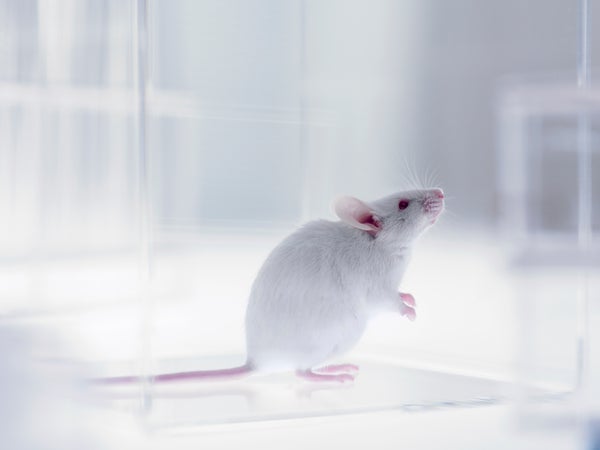
The 70 million neurons in the mouse brain look like a tangled mess, but researchers are beginning to unravel the individual threads that carry messages across the organ. A 3D brain map released on 27 October, called MouseLight, allows researchers to trace the paths of single neurons and could eventually reveal how the mind assembles information.
The map contains 300 neurons and researchers plan to add another 700 in the next year. “A thousand is just beginning to scratch the surface,” says Nelson Spruston, a neuroscientist at the Howard Hughes Medical Institute (HHMI) Janelia Research Campus in Ashburn, Virginia.
To create the maps, Spruston and HHMI neuroscientist Jayaram Chandrashekar injected mouse brains with viruses that infect only a few cells at a time, prompting them to produce fluorescent proteins. The team made the organs transparent using a sugar-alcohol treatment to obtain an unobstructed view of the glowing neurons, and then scanned each brain with a high-resolution microscope. Computer programs created 3D models of the glowing neurons and their projections, called axons, which can be half a metre long and branch like a tree.
On supporting science journalism
If you're enjoying this article, consider supporting our award-winning journalism by subscribing. By purchasing a subscription you are helping to ensure the future of impactful stories about the discoveries and ideas shaping our world today.
MouseLight has already revealed new information, including the surprisingly extensive number of brain regions that a single axon can reach. For instance, four neurons associated with taste stretch into the region that controls movement and another area related to touch. Chandrashekar says the group is now working on identifying which genes each neuron expresses, which will help to pin down their function.
“This is a tremendous project,” says Hongkui Zeng, a molecular biologist at the Allen Institute for Brain Science in Seattle, Washington, who plans to collaborate with the Janelia group on MouseLight. The Janelia technique is similar to one that Zeng and her colleagues developed using a line of mice genetically engineered so that a certain drug activates glowing proteins in a handful of their neurons.
MouseLight is just one of several methods being used to reconstruct individual neurons, says Rafael Yuste, a neurobiologist at Columbia University in New York City. Accurately labelling neurons with markers such as fluorescence, he says, will probably be the key challenge in the eventual goal of creating a “census” of different cell types in the brain.
But to achieve that goal, Zeng says, researchers may need to reconstruct hundreds of thousands of neurons. “Now it’s a numbers game.”
This article is reproduced with permission and was first published on October 27, 2017.