
Five billion people, or around two-thirds of the world’s population, will face at least one month of water shortages by 2050, according to the first in a series of United Nations reports on how climate change is affecting the world’s water resources.
The assessment from the World Meteorological Organization, released Tuesday, includes projections about river flows, floods and droughts on every continent. It offered a mixed bag of findings, but warned that water security would become increasingly uneven across the world. Some places, such as Brazil’s Rio São Francisco basin, face a challenging future; others, including the Great Lakes region of the United States, are in better shape.
“The impacts of climate change are often felt through water—more intense and frequent droughts, more extreme flooding, more erratic seasonal rainfall and accelerated melting of glaciers—with cascading effects on economies, ecosystems and all aspects of our daily lives,” WMO Secretary-General Petteri Taalas said in a release. “And yet, there is insufficient understanding of changes in the distribution, quantity, and quality of freshwater resources.”
On supporting science journalism
If you're enjoying this article, consider supporting our award-winning journalism by subscribing. By purchasing a subscription you are helping to ensure the future of impactful stories about the discoveries and ideas shaping our world today.
The 36-page report “aims to fill that knowledge gap and provide a concise overview of water availability in different parts of the world,” he added.
The findings also will help guide climate adaptation and mitigation investments and inform the United Nations’ campaign to provide universal access to early hazard warning systems for climate disasters such as flood and drought.
As with other climate change phenomena, there will be losers and winners, the authors wrote, though, “Overall, the negative trends are stronger than the positive ones.”
In the United States, for example, persistent drought is projected to take an even larger toll on water security in the West. But the Great Lakes region will see relatively high water security due to the region’s proximity to five of the world’s largest freshwater lakes.
Other regions projected to have above-average water storage capacity in 2050 include the Niger basin in West Africa, the East African Rift and the northern Amazon basin, scientists said.
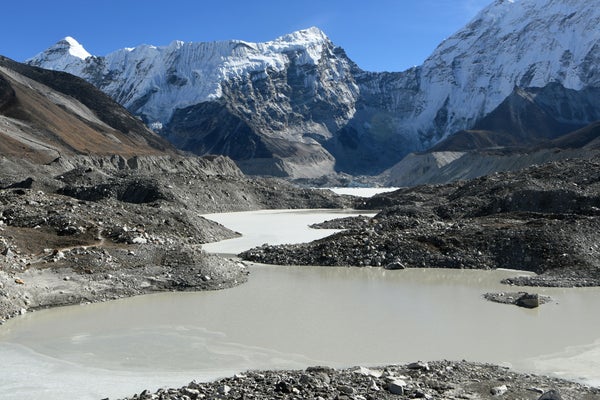
Conversely, the report identified several global “hotspots with negative trends” on water storage, including Brazil’s Rio São Francisco basin, Patagonia in the southern reaches of South America, the Ganges River headwaters in the Himalaya Mountains of northern India and the Indus River flowing from Tibet to the Arabian Sea.
Researchers said rapid snow and ice melt in high-elevation regions is having “a significant impact” on global water security, as does heavy use of groundwater for irrigation, a problem compounded by drought and the shrinking surface reservoirs.
Another key finding was that the global area with below-average stream flow in 2021 was roughly double the size of the global area with above-average stream flows, based on 30-year hydrological averages. Scientists attributed the 2021 conditions to both climate change and a La Niña event, an atmospheric oscillation pattern characterized by wide water temperature variation in the Pacific Ocean.
Between 2001 and 2018, the United Nations reported that 74 percent of all natural disasters were water-related—prompting participants at the recent U.N. climate conference in Egypt to further integrate water into adaptation efforts. Officials said it is the first time water has been referenced in a COP document recognizing its critical importance.
Reprinted from E&E News with permission from POLITICO, LLC. Copyright 2022. E&E News provides essential news for energy and environment professionals.