5 Quick Facts about NASA’s Juno Mission to Jupiter

What is so risky about Juno’s special maneuver? How close will the spacecraft get to the gas giant, and what does it hope to learn? Here are five quick facts summarizing the excitement around the recent Juno mission to Jupiter

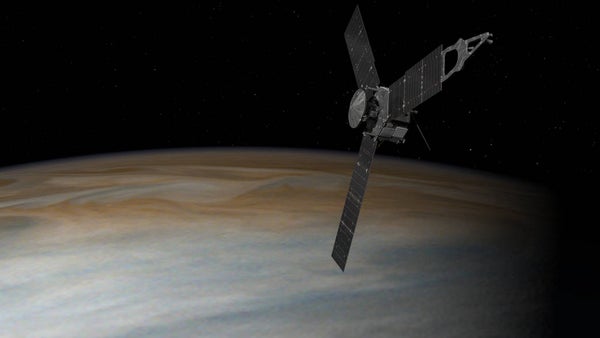
This illustration depicts NASA's Juno spacecraft in orbit above Jupiter.

Join Our Community of Science Lovers!


Late on the night of July 4th, NASA team members spent a suspenseful 35 minutes watching as the spacecraft Juno attempted to enter the region around the gas giant planet Jupiter, using a risky maneuver known as an orbital insertion. The main goal of this mission is to learn more about the origin and evolution of Jupiter, which will ultimately improve our understanding of how our entire solar system came to be.

What is so risky about Juno’s orbital insertion maneuver? How close will the spacecraft get to the gas giant, and what does it hope to learn? Here are five quick facts summarizing the excitement around the Juno mission.


On supporting science journalism

If you're enjoying this article, consider supporting our award-winning journalism by subscribing. By purchasing a subscription you are helping to ensure the future of impactful stories about the discoveries and ideas shaping our world today.


1. Juno will get closer to Jupiter than any previous spacecraft ever has

Jupiter is surrounded by an intense band of highly energetic charged particles known as a "radiation belt." A planet’s magnetic field offers protection against such particles, but will also cause them to be trapped along the magnetic field lines in toroid, or donut-shaped, belts.

Mercury, Jupiter, Saturn, Uranus, and even Earth are known to have radiation belts. Venus and Mars, however, do not have significant magnetic fields, and so do not have the ability to trap particles. Jupiter has the strongest magnetic field in the solar system, at nearly 20,000 times stronger than that of the Earth.

»Continue reading on QuickAndDirtyTips.com

It’s Time to Stand Up for Science

If you enjoyed this article, I’d like to ask for your support. Scientific American has served as an advocate for science and industry for 180 years, and right now may be the most critical moment in that two-century history.

I’ve been a Scientific American subscriber since I was 12 years old, and it helped shape the way I look at the world. SciAm always educates and delights me, and inspires a sense of awe for our vast, beautiful universe. I hope it does that for you, too.

If you subscribe to Scientific American, you help ensure that our coverage is centered on meaningful research and discovery; that we have the resources to report on the decisions that threaten labs across the U.S.; and that we support both budding and working scientists at a time when the value of science itself too often goes unrecognized.

In return, you get essential news, captivating podcasts, brilliant infographics, can't-miss newsletters, must-watch videos, challenging games, and the science world's best writing and reporting. You can even gift someone a subscription.

There has never been a more important time for us to stand up and show why science matters. I hope you’ll support us in that mission.

Thank you,

David M. Ewalt, Editor in Chief, Scientific American

Subscribe