
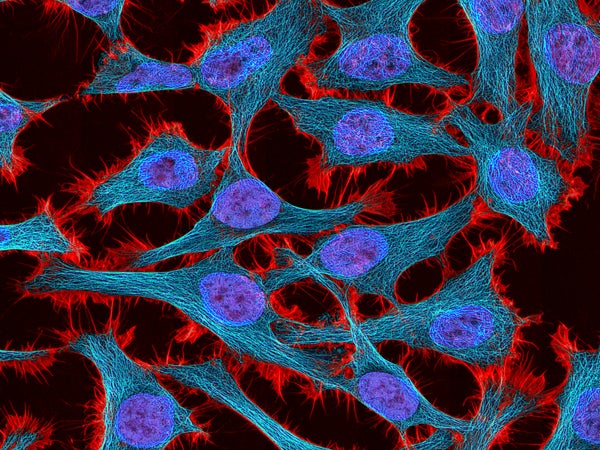
Henrietta Lacks’s cells have long been familiar to scientists — but it was the ethical controversy around those cells that made her famous to the wider world.
Her fame was thanks to an award-winning book published in 2010 that explored how, in the course of Lacks’s treatment for cancer, doctors isolated what became the first “immortal” human cells. The HeLa cells survived, thrived, and multiplied outside her body, so much so that they have been in continual use in labs around the world for 65 years, even though Lacks herself succumbed to cancer in 1951. But their use has raised challenging issues about medical samples taken without consent and how individuals and their families should be compensated for discoveries based on their tissues.
Now, that story is the subject of an HBO movie coming out later this month, making it an opportune time to reflect on who Henrietta Lacks was and what her cells have contributed to science. Here are just a few of them.
On supporting science journalism
If you're enjoying this article, consider supporting our award-winning journalism by subscribing. By purchasing a subscription you are helping to ensure the future of impactful stories about the discoveries and ideas shaping our world today.
Vaccinating girls against cancer
In the early 1980s, German virologist Harald zur Hausen found that HeLa cells contained multiple copies of human papillomavirus 18 (HPV-18), a strain of HPV later found to cause the type of cervical cancer that killed Lacks. HPV-18 was found to be one of the most dangerous strains of the virus, inserting its DNA into normal cells and forcing them to produce proteins that ultimately lead to cancer. In Lacks’s case, the virus entered the cells and turned off the gene that would normally have suppressed the formation of tumors. Years later, scientists used that knowledge to develop HPV vaccines, which are now widely available and credited with reducing cases of HPV infection in teenage girls by almost two-thirds. Harald zur Hausen won a 2008 Nobel prize for his discovery.
Showing us how cells stay young
Because of the seemingly limitless lifespans of Lacks’s cells, we now understand better how some cells manage to stay “young” even with the passage of time. Usually, as cells divide — either as a person grows or as the body repairs injuries — each division lops off the ends of chromosomes, called telomeres. Over time that means that the chromosomes become slightly shorter, which is thought to be a driver of cell aging.
In the 1980s, it was discovered that some animal embryos had an enzyme called telomerase, which protects chromosomes from degrading, allowing the cells to keep actively dividing. Then, in 1989, Yale scientist Gregg Morin used HeLa cells to isolate the same enzyme in human cells for the first time. Morin hypothesized that this enzyme, found in cancer cells, was also how embryonic cells were able to rapidly divide at the beginning of life. And in 1996, he was proven right, when scientists found telomerase in human embryos — which is what allows them to grow so rapidly until birth, when human bodies stop making it.
Eradicating polio
At the time of Lacks’s death, polio was one of the world’s most devastating viral diseases. HeLa cells helped make the vaccine available sooner. In the early 1950s, Jonas Salk had already figured out how the vaccine worked; the problem was testing it. Ordinarily, Salk would have tested the vaccine on cells from monkeys. But monkeys and their cells were expensive, especially considering that testing the vaccine actually killed the cells in the process. Ideally, the best cells for testing would be susceptible to infection by the poliovirus, but wouldn’t be killed by it. No such cells existed until researchers found HeLa cells. Not only were these cells more susceptible to the virus than the cells scientists previously used, the fast-growing cells were nearly impossible to kill. Scientists at the Tuskegee Institute built a factory to reproduce HeLa cells, allowing Salk to successfully test the vaccine, which in the last 60 years has effectively eliminated polio in most of the countries of the world.
Mapping the human genome
In in mid-1960s, HeLa cells were fused with mouse cells, creating the first documented human-animal hybrid cells. Those cells, in turn, became important in the early days of gene mapping. Because every hybrid would have a different assortment of human and mouse genes, scientists could look at what proteins a cell did or didn’t produce and deduce which human gene they were produced by. Those techniques evolved over time into the fine-scale map of the human genome that emerged from the Human Genome Project.
European scientists later published Lacks’ genome, but removed it from public view after her family protested. In 2013, the National Institutes of Health and Lacks’s descendants released a special set of rules for handling the Lacks genome.
Creating the field of virology
Over the years, scientists have infected hardy HeLa cells with various viruses — HIV, herpes, Zika, measles, and mumps, to name a few — to better understand how to battle them. They discovered, for instance, that the type of white blood cell called a T cell sports a surface protein called CD4, which is what HIV uses to enter the cell. When CD4 was added to HeLa cells they could be infected with HIV, allowing HIV drugs to be tested on HeLa cells.
Researchers also learned that the measles virus constantly mutates when it infects HeLa cells, making the disease harder to fight. More recently, microbiologists found that Zika cannot multiply in HeLa cells. Digging further into why that is could produce a new treatment or vaccine for the disease.
Republished with permission from STAT. This article originally appeared on April 14, 2017