5 Years of Record Warmth Intensify Arctic's Transformation

Sea ice is the thinnest it's been at any time in the last 30 years, and wild reindeer and caribou populations continue to decline

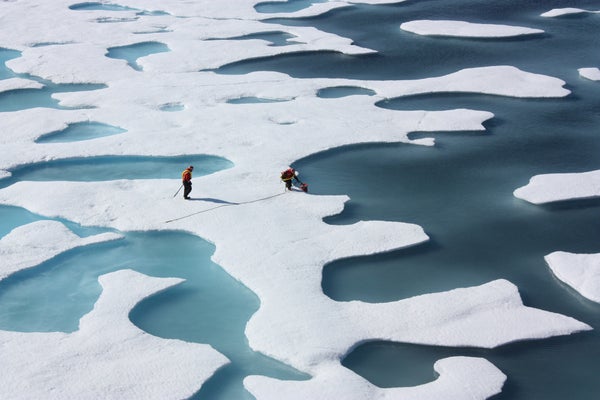
Most of the sea ice that forms in the Arctic is thinner than it's been in decades.

Join Our Community of Science Lovers!

The Arctic experienced its second-warmest year on record between October 2017 and September 2018, according to the annual Arctic Report Card. And average air temperatures in this frigid region have hit record or near-record levels every year since 2014.

Temperatures in the Arctic are now increasing at roughly twice the rate of the global average, researchers say in the report released by the US National Oceanic and Atmospheric Administration (NOAA).

Warming is causing changes across the entire Arctic, and those changes are building, said Emily Osborne, the programme manager at the NOAA Arctic Research Program in Silver Spring, Maryland. She helped to present results from the report on 11 December during a meeting of the American Geophysical Union in Washington DC.


On supporting science journalism

If you're enjoying this article, consider supporting our award-winning journalism by subscribing. By purchasing a subscription you are helping to ensure the future of impactful stories about the discoveries and ideas shaping our world today.


Wild reindeer and caribou populations, for example, have declined by more than 50% since the 1990s. And more than 99% of sea ice is now considered relatively new, meaning that it hasn’t lasted for more than four summers without melting. It’s now the thinnest and most susceptible to warming temperatures that it's been in 30 years.

Harmful algal blooms are seven times more prevalent off the Alaskan coast than they were 40 years ago. And the Arctic Ocean now contains the highest concentration of microplastics of any ocean basin in the world, according to the report.

The microplastics and algal bloom findings really surprised Donald Perovich, a geophysicist at Dartmouth College in Hanover, New Hampshire, who worked on the report card. “Even here—the farthest point on Earth—we’re still seeing impacts from lower latitudes,” he says.

This article is reproduced with permission and was first published on December 11, 2018.

About Jeremy Rehm

Jeremy is a science writer currently in the University of California, Santa Cruz Science Communication Program.

More by Jeremy Rehm

First published in 1869, Nature is the world's leading multidisciplinary science journal. Nature publishes the finest peer-reviewed research that drives ground-breaking discovery, and is read by thought-leaders and decision-makers around the world.

More by Nature magazine

It’s Time to Stand Up for Science

If you enjoyed this article, I’d like to ask for your support. Scientific American has served as an advocate for science and industry for 180 years, and right now may be the most critical moment in that two-century history.

I’ve been a Scientific American subscriber since I was 12 years old, and it helped shape the way I look at the world. SciAm always educates and delights me, and inspires a sense of awe for our vast, beautiful universe. I hope it does that for you, too.

If you subscribe to Scientific American, you help ensure that our coverage is centered on meaningful research and discovery; that we have the resources to report on the decisions that threaten labs across the U.S.; and that we support both budding and working scientists at a time when the value of science itself too often goes unrecognized.

In return, you get essential news, captivating podcasts, brilliant infographics, can't-miss newsletters, must-watch videos, challenging games, and the science world's best writing and reporting. You can even gift someone a subscription.

There has never been a more important time for us to stand up and show why science matters. I hope you’ll support us in that mission.

Thank you,

David M. Ewalt, Editor in Chief, Scientific American

Subscribe