
1970 Gene Switches
“How are genes controlled? All cells must be able to turn their genes on and off. For example, a bacterial cell may need different enzymes in order to digest a new food offered by a new environment. As a simple virus goes through its life cycle, its genes function sequentially, directing a series of timed events. As more complex organisms develop from the egg, their cells switch thousands of different genes on and off, and the switching continues throughout the organism's life cycle. This switching requires the action of many specific controls. During the past 10 years one mechanism of such control has been elucidated in molecular terms: the control of specific genes by molecules called repressors.—Mark Ptashne and Walter Gilbert”
Gilbert was the co-winner of the 1980 Nobel Prize in Chemistry for his work on nucleic acids.
On supporting science journalism
If you're enjoying this article, consider supporting our award-winning journalism by subscribing. By purchasing a subscription you are helping to ensure the future of impactful stories about the discoveries and ideas shaping our world today.
1920 Voice Amplification
“The loud-speaking telephone system which has been placed in the Coliseum at Chicago has been in process of development for about ten years. The work was mostly done in the laboratory on one of the busiest and noisiest water-front streets in New York. Amidst all the rattle and bang of a thousand teams and motor trucks pounding the stone pavement, teamsters were startled to hear a strange voice, apparently close to their ears, deliberately and clearly reciting some rhyme like ‘Hickery, dickery, dock, the mouse ran up the clock.’ Those teamsters could hardly see the horn on the roof of the lofty laboratory building, nor guess that tests were being made which would facilitate the nomination of a presidential candidate.”
1870 Machine Age
“A single establishment in this city—the Singer Sewing Machine Company—turns out five hundred sewing machines per diem. The works are run night and day.”
Wired for Beauty
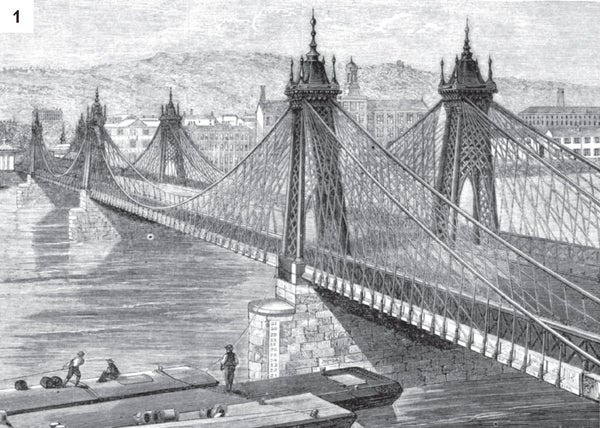
“The Allegheny Bridge at Pittsburgh: We believe we express a general opinion among engineers and architects when we say that the bridge which forms the subject of our engraving this week is one of the most elegant structures of its class on this continent. Nothing can exceed the grace of its outline when seen from a favorable point of view. This beautiful bridge was designed and erected in 1860, by the late John A. Roebling.”
The Sixth Street Bridge was demolished in 1892 to make way for a more robust structure capable of withstanding modern traffic.
Bridges: An “Index of Civilization”
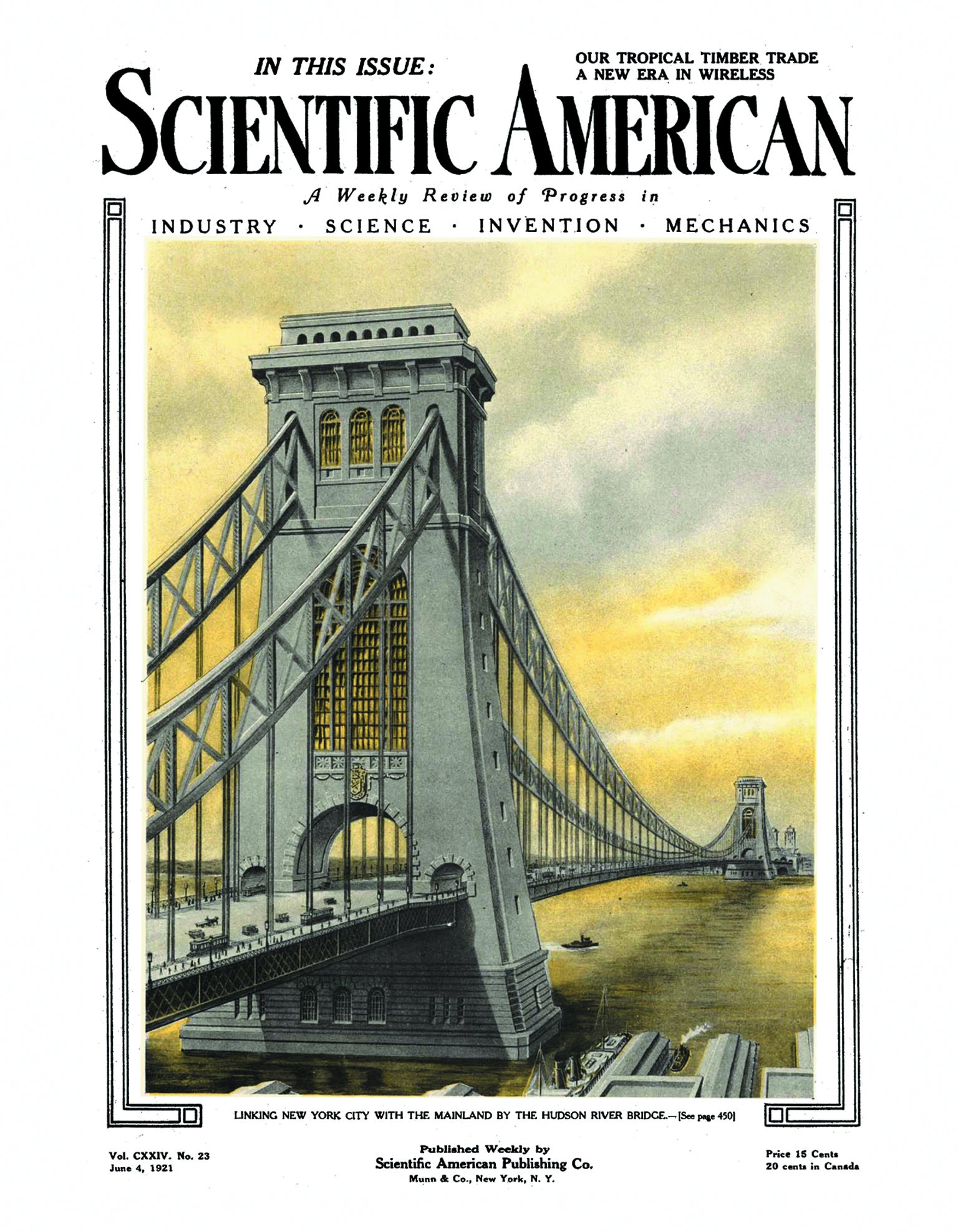
1921: Overly expensive design for the future George Washington Bridge spanning the Hudson in New York City. Credit: Scientific American, Vol. CXXIV, No. 23; June 4, 1921
The engineering skill to build bridges across natural barriers speaks volumes about humanity's capacity to facilitate future travel needs. Neolithic wood walkways above marshes in England date back some 6,000 years. Wood gave way to stone, then iron. The availability of cheap steel from the Bessemer process in the late 19th century opened up a new era of bridge building: graceful steel forms spanned greater and greater distances. In November 1921 an article noted that bridges mark “the progress of mankind in the art of construction, considered as an index of its civilization and culture.” Today the longest bridge—over canals, rice paddies and lakes—is 102 miles long and carries the Beijing-Shanghai high-speed rail link.
