
1970
Lunar Laser Reflector
“In July of last year the astronauts of Apollo 11 placed on the surface of the moon an array of prism-like reflectors that has made it possible to measure the distance between the earth and the moon with an accuracy approaching six inches. The important quantity, however, is not the absolute distance between the earth and the moon but the variations in distance measured over a period of months and years. Such variations can be studied to answer important scientific questions, such as how the mass inside the moon is distributed, the rate at which the continents on the earth are drifting toward (or away from) one another and changes in the location of the earth’s North Pole (which shifts in response to unknown forces). A more fundamental question than any of these is whether the gravitational constant is indeed constant or whether it may slowly be weakening with the passage of time.”
On supporting science journalism
If you're enjoying this article, consider supporting our award-winning journalism by subscribing. By purchasing a subscription you are helping to ensure the future of impactful stories about the discoveries and ideas shaping our world today.
1920
Calling Mars
“The recent suggestion that the Martians are trying to send wireless signals to us may prove groundless, but it has at least called public attention to an important subject. The idea of exchanging thoughts with intelligent beings on another planet is too alluring for the human imagination to resist. To bring the public to the necessary point of enthusiasm, they must be assured that an exchange of signals will rapidly develop into an exchange of ideas on any and all subjects of common interest. We want to talk over our scientific, social and religious notions with the Martians, and if they have a civilization far older than ours we want to learn from them truths that will help us in our own difficulties.”
1870
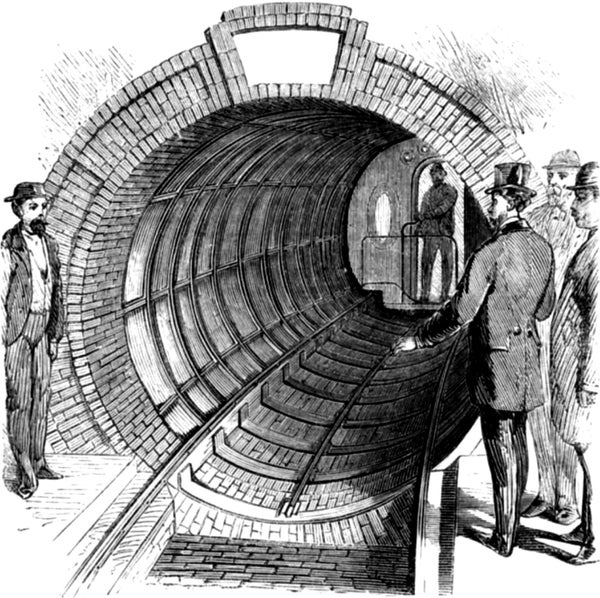
Pneumatic Subway
“The doors of the Beach Pneumatic Transit Company were thrown open to the public for the first time when an ‘Under Broadway Reception’ was given, by special invitation to the State authorities, city officials, and members of the press. All the prominent personages of the city and State were present, and the inspection of the works gave the greatest satisfaction. The various daily newspapers have published long accounts of the event, which has produced quite a novel sensation in the metropolis. The New York Herald says ‘it was virtually the opening day of the first underground railway in America.’”
This demonstration project was designed and built by Alfred Ely Beach, then editor of this magazine.
People Movers
Cities are well served by extensive transportation networks that move people and goods into, out of and around urban conglomerations on a daily—or hourly—basis. But there is a question of how to power these people movers. The London Underground, opened in 1863, had coal-fired steam engines pulling gas-lit cars along “tube” tunnels. It must have been spectacularly grimy. San Francisco’s cable cars grab hold of moving cables under the street, which are powered by static engines. Alfred Ely Beach, an early editor in chief here, demonstrated an underground railcar puffed along by air pressure in 1870 (1). Entrepreneur Elon Musk’s proposed Hyperloop plans to zip railcars through a near vacuum inside a tube. As networks of rails over and under the ground expanded with cities, they were melded with electric power grids (2) to create faster and cleaner urban transit systems. These networks now serve hundreds of millions of riders a day worldwide, and their efficiency may help mitigate climate change as populations grow. —D.S.