
1970
Monkey War Resumes
“The classic controversy about evolution has resumed once again in California. The State Board of Education inserted into new guidelines, which had been prepared by a committee of science teachers, a statement that ‘scientific evidence concerning the origin of life implies at least a dualism or the necessity to use several theories.’ This will presumably require that such competing theories as the story given in Genesis and Aristotle's theory of spontaneous generation be taught along with Darwinism. The decision could affect the teaching of biology throughout the country, since California accounts for some 10 percent of all textbook sales and publishers are not likely to give up the California market or to publish special versions tailored to one state's requirements.”
On supporting science journalism
If you're enjoying this article, consider supporting our award-winning journalism by subscribing. By purchasing a subscription you are helping to ensure the future of impactful stories about the discoveries and ideas shaping our world today.
1920
Airborne Horse
“From Santa Barbara, California, comes word that a horse entered in an exposition held in that city arrived by airplane from Los Angeles. The trip was delayed a day until officers of the Humane Society were fully convinced that no cruelty was involved in the trip.”
Vehicle Link
“Strikes of one sort or another have emphasized New York City's physical isolation and made it imperative that the Island of Manhattan have transportation links that will permit a continual interchange of vehicular traffic between the New Jersey and the New York side of the Hudson River. It should be no wonder to the technical world that Chief Engineer Clifford M. Holland, and his associate experts, should have decided in favor of twin cast-iron tubes and the adoption of the shield method of tunneling. This procedure has heretofore been followed in the driving of twenty-two railroad tubes under the Hudson and the East Rivers.”
The Holland Tunnel opened in 1927.
1870
Live Animal Trade
“An English magazine says, ‘the trade in wild beasts is a system as regular as the trade in tea, coffee, or cotton. Some creatures, of which parrots are the most numerous, are brought over by sailors, who intend them, perhaps, as presents for their sweethearts, but they sell them for grog or tobacco as soon as they land. If any gentlemen or lady would like an elephant for private riding, a tiger as an ornament to the garden, a crocodile or hippopotamus for the lake, or an ostrich or emeu for the lawn, the wish can be gratified by merely addressing a letter to the London dealer.’”
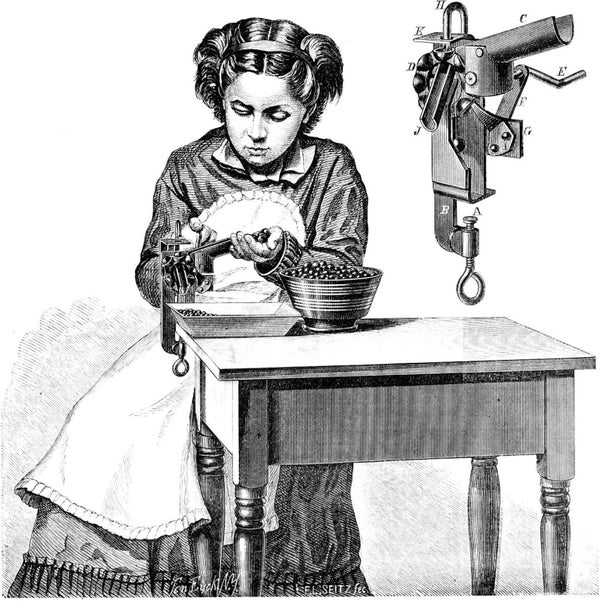
Food Prep at Home
“We publish an engraving of a neat and ingenious device for removing the pits from cherries, plums, and the like, and also the seeds from raisins, cranberries, etc. The improved form of the machine was patented by George Geer, of Galesburg, Ill.”

Epic Tales
The Evolution and Technology of How We Eat

Neolithic bones from a woman who lived in northern Syria 10,000 years ago bear distinctive marks of the hard labor of grinding grains. Credit: Scientific American, Vol. 271, No. 2; August 1994
The way humans prepare food is intertwined with our evolution and our technology. The first use of fire to cook food unlocked nutrition not available in raw foods. Our cover from August 1994 (“The Eloquent Bones of Abu Hureyra”) shows the toll on Neolithic skeletons of the effort spent grinding grains after the rise of agriculture 12,000 years ago. In the mid-19th century most food (for instance, the cherries shown above) was generally grown close to home and processed and eaten there. A continual stream of innovations in transport, refrigeration, shipping, mass processing and agriculture (Mike Bloomberg, please take note) has brought us our modern system of food, with all its benefits and the complex side effects that bedevil us.