
50,000,000 YEARS AGO
HUGE SHOES FOR SALE—“Standing at the podium, Lionel B. Ambulocetus, the president of the International League of Whales, was brief in his remarks, but there was no mistaking his anger. ‘That’s it, we’re getting out of here,’ he proclaimed. ‘Life on land has no future, so we’re returning to the seas. I’ve urged all our members to begin spending more time at the beach and to look for mates with shorter legs. We know it’s not going to happen overnight, but we’re going back to the oceans where we belong.’ Staring down at his own feet, he said, ‘A day will come when I need these like a hole in the head.’
“Mr. Ambulocetus was not shy about explaining the reasons for the whales’ planned migration. ‘Quite frankly, it’s the primates. I know they’re small and there aren’t very many of them, but they make an unbelievable amount of noise, and their little grasping forefeet give me the creeps. We are convinced that the primates are going to cause a lot of trouble for everyone, and we don’t want to be around when it happens. At least in the oceans, we’ll be safe.’”
On supporting science journalism
If you're enjoying this article, consider supporting our award-winning journalism by subscribing. By purchasing a subscription you are helping to ensure the future of impactful stories about the discoveries and ideas shaping our world today.
100,000,000 YEARS AGO
WATCH THE SKIES?—“At a recent interdisciplinary meeting on the campus of Pangaea University, researchers discussed with some alarm the mounting evidence that each of the known mass extinction events may have been caused by a titanic collision of a comet or asteroid with the earth. According to recent speculations, such impacts could envelop our planet in a dense cloud of dust and ash, blocking out the sun, with disastrous consequences for most life-forms.
“Massive impact scenarios should be of more than academic interest, many of the gathered scientists said, because a similarly calamitous collision could occur yet again. ‘It’s difficult to predict how bad it could be,’ remarked geologist Edward Deinonychus of Gondwana Polytechnic. ‘It would surely cause a huge loss of saurian life, maybe even amounting to 10 percent of the population. What’s more, even aside from its climatic effects, the impact could ignite a gigantic firestorm. It might destroy every last trace of our magnificent papier-mâché cities.’
“Some of the participants at the meeting argued that a future mass extinction could be averted. ‘Our space science is now sufficiently advanced for us to identify an incoming asteroid decades before its arrival and to change its course,’ said Margaret Dimetrodon of Mount Ararat Observatory. ‘I know it sounds like science fiction. But if we can put a sauropod on the moon, then we can do this.’
“But support within the government for investing in an asteroid-blasting scheme remains weak. Echoing sentiments heard throughout Congress, junior senator Strom Thurmond declared, ‘Even if it is a good idea, a big collision like this might not occur for tens of millions of years. That’s more than enough time for us to get it done. Right now we’d be better off putting our science funding to more worthwhile uses, like fusion research.’”
150,000,000 YEARS AGO
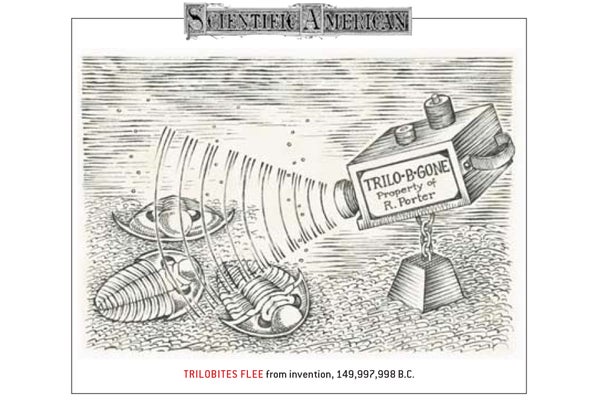
PEST CONTROL—“A new patent has been issued to Mr. Rufus Porter, an ichthyosaur, for the eradication of unwanted trilobites. The device emits a high-pitched tone that resonates with the exoskeletal chitin of the arthropods, setting up vibrations that the animals would presumably find painful.
“Issuance of this patent was held up for some time when one of the examiners questioned the need for such an invention insofar as trilobites are widely considered to be extinct, none having been seen for approximately 70 million years. Mr. Porter’s answer was that this absence of trilobites only demonstrated the effectiveness of his invention. Copies of the patent can be obtained as of April 1.”