
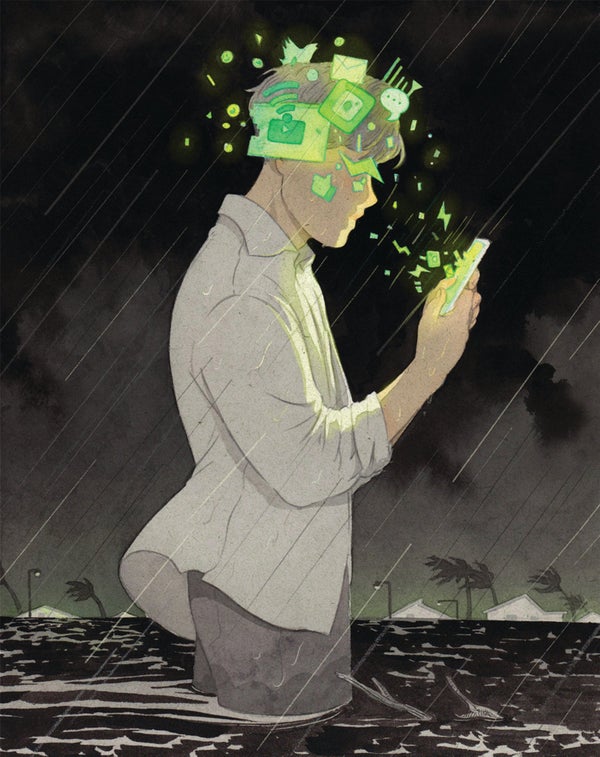
The rollout of 5G wireless technology will make mobile communications dramatically faster and more efficient. But 5G could also lead to dangerous setbacks for weather forecasting. That is the worry voiced by national and international science agencies and independent experts. The Federal Communications Commission (FCC), however, which regulates U.S. wireless networks, doesn’t seem concerned—and that’s a big problem.
5G promises better performance than earlier generations of wireless telecommunications. Some of 5G’s frequency bands, however, are perilously close to those used by weather instruments on Earth-orbiting satellites. The 5G transmissions at 24 gigahertz can overlap with the 23.8-GHz signal naturally emitted by atmospheric water vapor and monitored by these instruments. Visible in day or night, through clear or cloudy skies, the 23.8-GHz signal is a reliable indicator of humidity that is used to sharpen weather forecasts—including the strengths, locations and paths of storms—on scales from hours to days. Unless, that is, the data are disrupted by some source of interference—such as the signals emitted by new 5G base stations and devices.
That interference is measured in units called decibel watts, and several agencies have called for relatively strict limits on how much of this electronic noise is permissible—the more negative the number, the stricter. The European Commission, for example, set a maximum threshold of −42 decibel watts. But during an inaugural auction last year for U.S. rights to use the 24-GHz transmission band, the FCC set a much looser noise limit of −20 decibel watts—well in excess of ceilings based on studies from NASA, the National Oceanic and Atmospheric Administration (NOAA), and the U.S. Navy. After the auction, NOAA acting administrator Neil Jacobs told Congress that the FCC’s lax noise limits would result in as much as a 77 percent drop in satellite water-vapor data. This, Jacobs said, could lead to a two- to three-day lag in predicting the movements of hurricanes, effectively throwing the nation’s satellite-based forecasting capabilities back to 1980 levels. Moreover, Jacobs testified, 5G interference could force NOAA to abandon plans for new weather satellites.
On supporting science journalism
If you're enjoying this article, consider supporting our award-winning journalism by subscribing. By purchasing a subscription you are helping to ensure the future of impactful stories about the discoveries and ideas shaping our world today.
Yet late last fall delegates of the International Telecommunication Union Radiocommunication Sector (ITU-R), the organization managing global radio-spectrum use, agreed to introductory 5G noise limits of between −29 and −33 decibel watts. Taking effect this year, the ITU-R limits are more stringent than the FCC’s but are still likely to be a problem for meteorologists.
Responding to congressional concerns before last spring’s auction, commission chair Ajit Pai defended the decisions on 5G noise limits, calling criticisms “exaggerated and unverified last-minute assertions.” Yet it is the FCC, not its critics, that is failing to validate its claims: as of this writing, the commission has yet to produce any study supporting its recommended 5G noise limits. Meanwhile the agency is planning auctions of other 5G-frequency bands that overlap with satellite monitoring of precipitation, clouds and sea ice.
These actions are part of a broader, more disturbing pattern of imperious behavior by the FCC. The agency has already opened up previously protected regions of the radio spectrum for new uses while rapidly moving forward with approvals for globe-girdling constellations of satellites offering broadband Internet. Both types of activity could degrade a wide array of astronomical observations from ground-based telescopes, and a massive influx of new satellites also poses significant risks of creating more “space junk,” which already threatens existing orbital assets, including the International Space Station.
Fortunately, the FCC is not unaccountable. In a rare instance of congressional bipartisanship, in December 2019 the top Democrat and Republican on the House Science Committee jointly asked the Government Accountability Office to investigate why, exactly, the FCC’s 5G recommendations differ so strongly from those of other federal agencies. This is a good start. Congress should use its considerable powers, budgetary and otherwise, to increase pressure on the FCC to “show its work” and to engage more meaningfully with dissenting government agencies, scientific institutions and other stakeholders to develop sustainable solutions for 5G—and for accurate weather forecasting.