
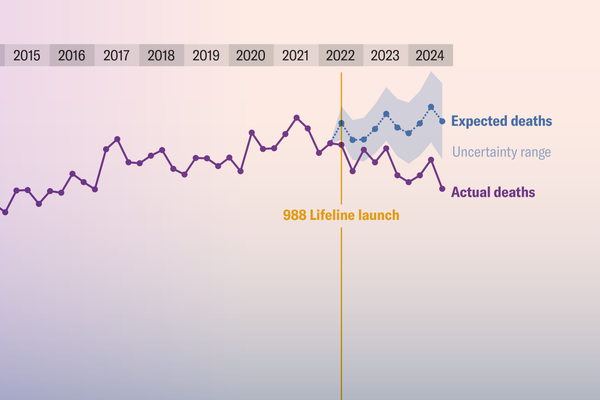
Since July 2022, people in the U.S. struggling with thoughts of suicide have been able to receive help by calling or texting the simple number “988.” Now an analysis of suicide mortality across the country has found that deaths among young adults have fallen in the time since the hotline was introduced.
“This is one of those rare moments in [this area of] public health where we can say that something might actually be working,” says Vishal Patel, the study’s lead author, who studies health care policy at Brigham and Women’s Hospital and Harvard Medical School. The results were published in JAMA on Wednesday.
Previous research has shown that calls to the crisis hotline, which had existed since 2005 under a 10-digit number, more than doubled after the number was shortened to 988 in 2022. Uptake was highest among young adults under age 30.
On supporting science journalism
If you're enjoying this article, consider supporting our award-winning journalism by subscribing. By purchasing a subscription you are helping to ensure the future of impactful stories about the discoveries and ideas shaping our world today.
Patel and his colleagues wanted to see if potential effects of the new 988 number would show up in the government’s data on deaths by suicide through 2024. They calculated the number of such deaths among adolescents and young adults aged 15 to 34 that would be expected after July 2022 if the 988 Lifeline hadn’t launched, then compared those numbers with actual deaths. Overall, the researchers found that the death rate was 11 percent lower than that expected number, which translated to more than 4,300 fewer deaths than expected.

The researchers found that the 10 states with the biggest relative increases in 988 hotline calls between 2022 and 2024 had an 18 percent decrease in suicide deaths. Those states were North Dakota, Virginia, Indiana, New York State, Rhode Island, Missouri, Maryland, Vermont, Connecticut and West Virginia. Meanwhile the 10 states with the smallest increases in Lifeline use— Tennessee, Alabama, Texas, South Carolina, New Mexico, Mississippi, Illinois, Delaware, Wisconsin and Maine—had a roughly 11 percent decrease in suicide deaths. The researchers say the Lifeline may have driven the significantly larger reduction in deaths in the states where its use increased the most.
States in the same group may have other things in common with one another, however, which makes it hard to establish whether the 988 Lifeline caused the changes. “988 uptake varies across states in ways that are unlikely to be random,” says Michiko Ueda-Ballmer, who researches mental health policy at Syracuse University and wasn’t involved in the new study. “States with higher uptake may also be those investing more broadly in suicide prevention” or in encouraging people to seek help, she says. “That makes it difficult to isolate the specific contribution of 988.”
One event that could have influenced the data is the pandemic. To account for this, the researchers also recalculated the number of expected deaths while leaving out the pandemic years. Deaths still remained lower than this expected number. This suggests that the downturn is not just the number of suicide deaths returning to their prepandemic baseline, Patel says.
The mental health crisis centers that answer 988 calls are funded partly by states. Most states still lack permanent sources of funding for the centers, a problem that may intensify as call volumes grow. And last year the Trump administration eliminated federal funding for special 988 services for LGBTQ+ youth.
Ueda-Ballmer notes that the general public still has limited knowledge of the 988 hotline and how it works. Many respondents in a recent survey reported concerns about forced hospitalization. (A white paper from 2024 found that such “involuntary emergency rescues” are rare.) In a study published last month, Ueda-Ballmer surveyed adults under age 50 about how they seek mental health support and found that 988 wasn’t on the radar of most people who responded—far more people cited generative AI than the Lifeline as a potential source of support.
“I see 988 as a promising and important part of the mental health support system, with real potential to expand its impact over time,” says Ueda-Ballmer. But the ways that people seek support in times of need are evolving quickly. “Going forward, 988 will need to compete not just for attention but for trust and [positive] perception.”
IF YOU NEED HELP
If you or someone you know is struggling or having thoughts of suicide, you can call or text the 988 Suicide & Crisis Lifeline at 988 or use the online Lifeline Chat.